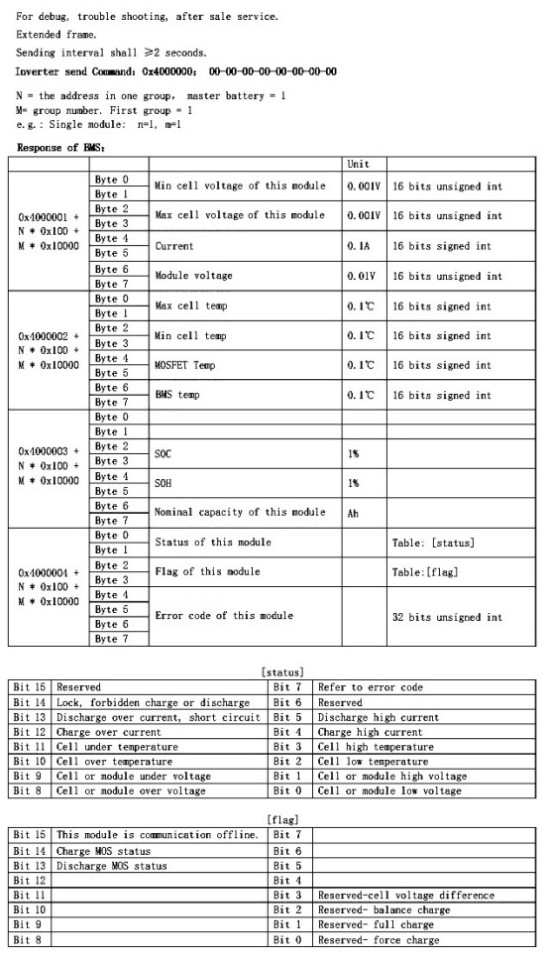
Yes.
It is possible to get in-depth monitoring on the GX. All cells etc and temps. It does depend on what the manufacturer has shared and to what address.
(Edited: remkved fet temps as they are more of a third party driver -unsupported possibility) And fairly unusual.
Vrm will only log/show min and max and the address of them. (Cell/battery Temps and voltage)
Thanks, great to know. If you or anyone know how to specifically ask for this kind of in depth support from a battery company that would be great.
Are you saying you can get voltage and temps for all individual cells at VRM now also? Warnings for individual cells?
I have had some bad experiences in the past with half-baked CANbus support so will try to avoid it this time around.
If it is not all at the VRM GUI, I would probably try to publish it in Node Red. I am basically looking for security to switch off, probably at the Lynx BMS, based on
error messages, Native Victron would be nice for this with 3d oat BMS but we shall see I guess,
Edited my previous answer.
The temperatures available are as available as the bms physical and firmware monitoring is.
This is not all published in the supported/normal drivers on the GX.
Some bms only have 1 or 2 probes in the battery bank, so that would be all you get if the bms publishes it. Some just use it for their own internal logic.
The usual approach for Victron integration is not Victron persuing all the battery companies in the world (that would be an impossible task) but the battery company approaching Victron to integrate with Victron support.
So if it is something you want from the company you are interested in supporting then you should propose that option to them
All the batteries on the supported list have basically approached Victron, got their required information and integrated.
As you probably know there are a few on Git that have drivers, one of them a pretty ‘famous’ one and well used.
One of the reasons why I like Victron is it is open enough for you and I to integrate and have a the opportunity where we can value add or as your self who will do it because they can.
The Venus OS shows the information that the BMS is sending.
Most BMS only send the highest/lowest cell voltage/temperature.
IMO that is enough. Why do you need the voltage/temperature of every single cell?
If you know the highest/lowest than you know all the others are between that.
Thanks for your reply @M_Lange I agree about the highest and lowest being enough for day to day use.
Would also think it can be useful with as much data as possible to catch trends and possible issues in time.
I appreciate the answer and am talking to a few battery makers in pretty much this way,
If it is in the Canbus stream it might be possible to at least get it visible in our Node Red Dashboards.
For relevance and completeness, I will also post here what I’ve posted elsewhere on the forum about what info can be obtained on a Cerbo-like device from a Pylontech set of batteries.
But for this it must be used a custom made utility/script that will interrogate the relevant information from the master battery.
Currently the Venus OS doesn’t have such utility.
Example of a small utility written in c: