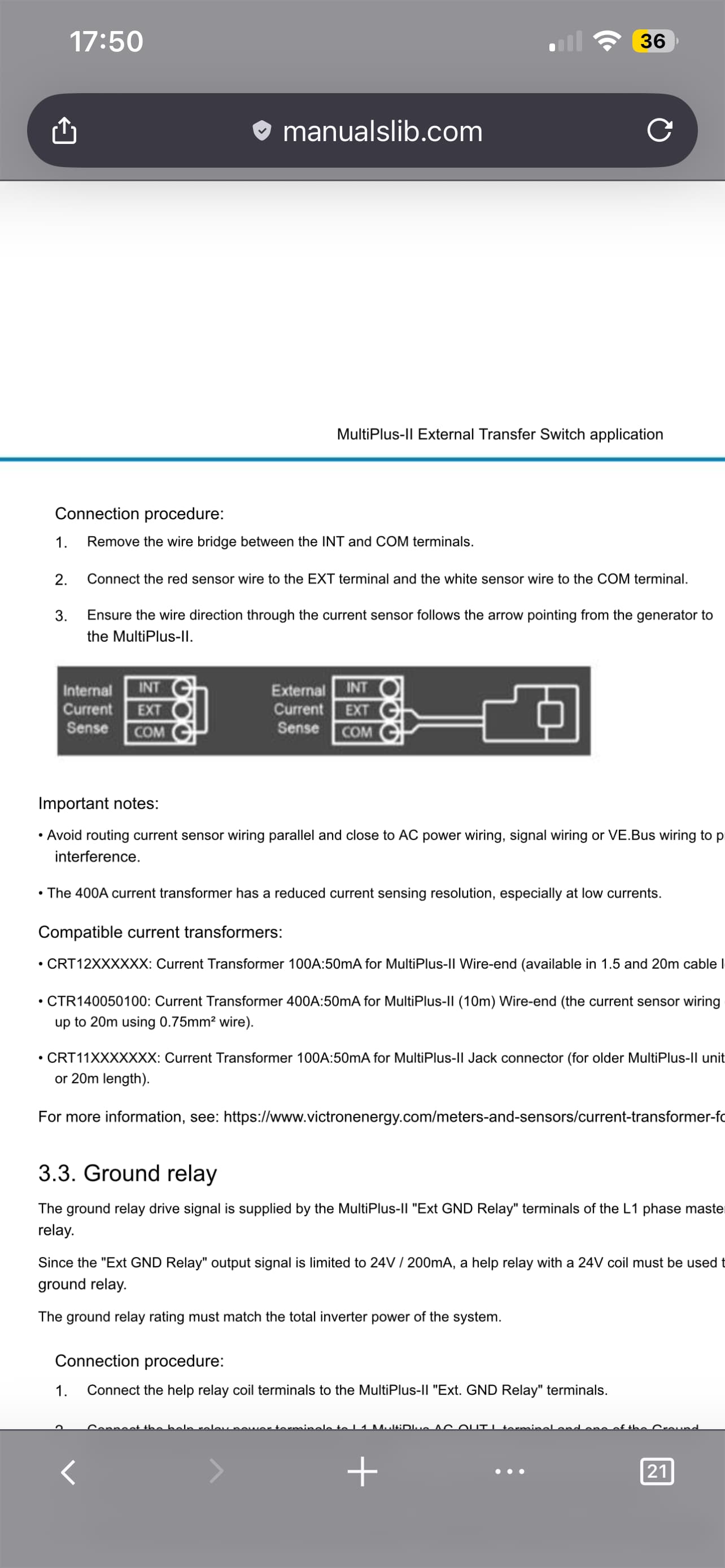
I have a Multiplus II 48/5000 based system with 12 solar panels charging a Gobelpower 314Ah/16kWh battery (JK 200A BMS connected to the CerboGX via CANBus) via 3 x SmartSolar 250/60’s (4 panels each) a smartshunt in the battery box controlling the MPPT’s and a CerboGX connecting the Multiplus and the MPPT’s to the net. I have a 100A/50mA CT clamp on the meter feed connected as COM/INT at the multiplus connector.
I’ve been running the system disconnected from the grid for the last 4 or so months with no issues, using the solar to charge the battery and running off the battery overnight.
I have applied for and received G98 export authorisation from my local DNO (Northern Power Grid) and now the days are getting shorter I feel it’s about time to reconnect the grid to ensure a run of poor solar days doesn’t leave me powerless and finally enable the multiplus to feed any excess back into it once the batteries are full on the good days.
I’ve updated all the firmwares on the components, and have loaded v558 onto the multiplus this morning.
Using VEConfigure 3 I have changed the Grid code settings from ‘None’ to UK:G98/1 Amendment 6 (16A Max) and sent the settings to the multiplus OK.
However when adding the ESS assistant in VEConfigure 3 I have come across an issue.
The online ESS manual am using (under How to add an Assistant from start to finish) suggests that I should be loading ‘grid converter support (0114)’ from the list of available assistants in VE Configure 3, but I don’t have that option in my list? I do have ‘ESS (Energy Storage System) (018E)’ and if I load this with the relevant settings for my system (LiFePO4 with BMS connected via CAN, 314Ah Battery Capacity, 50V sustain voltage, suggested cutoff’s and Inverter re-enable at 1.2V above cutoff ) it goes through it’s upload procedure turning the inverter off and on as if it’s uploading the settings OK, but when I look, the Battery Capacity always resets to 10Ah?? Any insight into this? Is it a fault or should I not be concerned?
I finally managed to get the ESS option showing on the CerboGX after the third try so now need some suggested settings to make it do what I want and export when the batteries are full.
A further problem has come up, I turned off the grid connection at the consumer unit to force the system to use the (now full) battery over the grid connection. As soon as I turned the breaker off I lost power to the house, I maybe foolishly assumed the UPS function would still apply when it’s in G98 mode but I notice that that tick box is not there when G98 is selected??
A few minutes later power came back on (Grid still disconnected) and it seemed to be OK for about 20 minutes until everything went off again? Battery is at 98% but I got a low battery warning on the VRM/Venus android tablet I have as a system monitor?
I’ve turned the G98 option off, gone back to None and everything is back as it was before I started all this, House is repowered, Solar is charging the Battery, Battery is at 99%, Multiplus is inverting and grid is still disconnected.
ESS should export automatically when batteries are full but this experience is only based on an AC solar setup, I’m not sure how the DC side works but I’m pretty sure I’ve seen export in the Cerbo for DC yeah here it is
I watched a youtube video that said to use the CT as if it is internal, Mine is not a plug in 3.5mm socket version but the 3 way rewirable plug, don’t know if this makes any difference.
I’ve reset the settings to None so ESS has vanished again, I do recall a switch for AC connected PV, but don’t remember the switch below being for DC? and if I switched off the AC option some of the buttons below vanished or were greyed out.
If I turn the mains back on, The inverter changes to Pass Thru and I see 208W on the Grid box after a few seconds, this is with the CT clamp connected to COM/INT and the 208W current animation is going from grid to inverter so the clamp is the right way around.
The CT clamp is on the Live conductor between Service Head and Grid meter. My own export meter hasn’t logged ANY export to the grid since it was installed.
@Grimreaper7 No see the instructions in the manual ext and com are used, int isn’t used when a CT on the newer models is used, the video depicts an old multiplus this was before the block connector which is the new type. Change your CT connections in the block to correspond with the instructions I posted.
PS move the CT under the isolation switch no point it being at the Service head which also looks like a looped supply so locate it after the smart meter as nothing should ever join before that, so just put it at the base of the isolation switch but that white cable is that double insulated never seen white cable that doesn’t look right.
I moved the CT clamp to after the disconnect switch and changed the wiring back to COM/EXT and it shows the same figures as when on COM/INT but it still wouldn’t load the ESS assistant correctly, it kept changing the 314Ah I was inputting back to 10Ah when I read the setting back after the Multiplus had restarted and there was no ESS assistant showing in the venus.local VRM.
I suspect it was the fact that the multiplus was connected to both my laptop AND the CerboGX. I disconnected the MP from the Cerbo, loaded the assistants from the laptop, let it restart, and read the settings back OK, then disconnected my laptop, reconnected the Cerbo to the MP, and ESS now appears in the VRM/venus.local.
Disconnecting the grid is seamless as before, so that works again.
Now I need to work out what settings I need to put into ESS to get it to do what I want it to do. The online ESS manual seems to be out of date, it shows options in the venus.local VRM that don’t exist on my current screens.
You only need ESS assistant and no PV. PV in B ESS assistant relates to amount of AC coupled PV in AC out which get throttled by frequency shifting while grid is missing and battery is getting full.
ESS normal operation is self-consumption. Surplus PV is charged to battery. If PV is less than loads, energy is inverted from battery to fill the gap. This is managed by “grid set point” in Venus menus ESS.
Feedback to grid es enabled in ESS by “allow DC feed-in” in your case.
I want, it to charge the battery with solar as much as possible and use the battery as much as possible without using any grid power (to keep the bills down), but once the battery is charged, export what the house doesn’t need until the sun goes down, then use the battery again. If the battery doesn’t get fully charged use it until its almost flat then use the grid to run the house but not to charge the battery, let the solar do that next day. That’s what I think most people would want to do so why make it so difficult to implement?
I’ve left it to do it’s own thing today while I’ve been out, so I don’t know if it’s exported anything (not looked at the meter yet) but the battery is full and seems to be running the house OK (everything works) it’s going between exporting 13W to importing 18W on the grid box on VRM so it looks like it’s working right just as it is but I need to understand what all the settings do to see if I can get it exactly how I want it.
@Grimreaper7 ESS does this automatically. You need to be-careful with running the battery super low as that’s what’s running the Multi and it isn’t designed to run purely on AC without the batteries. In my previous post I have posted how to export excess solar which would behave as you want it.
Hi Dave. I think I picked up in this thread that you are in UK? where we can have payments for exported power.
On my tariff, payment for export is about double the price of off-peak import.
So if your goal is minimum bills, it may be worth working out if you can use a different strategy “feed-in priority”. Paradoxically this involves increasing your grid consumption.
This is where, during the peak tariff day you charge the batteries as little as possible and export all the PV that is surplus to your loads (batteries supply any shortfall to keep grid imports near zero).
The batteries reach the nighttime off-peak tariff at a low SoC and you charge them from grid up to 100%
Hi David, Yes I’m in the UK, but I’m not on an export tarrif as yet, this is my first year of solar and battery ownership (self installed from start in January to finish at the end of May) so I’m not sure how much battery I’ll have left at the end of the night once the days get shorter. I’m hoping to only need grid assistance through November, December and January but will see how it goes.
I’m on Octopus already so I’m hoping their ‘non MCS installed’ option gets approval and then we’ll see how things work out. If I can get enough export payments to cover the standing charges I’ll be happy, any extra will mean my efforts will be rewarded and equipment costs covered earlier than planned.
I understand that Octopus do some of their own (desktop) approvals of non-MCS approved installations - at a cost to the applicant - and then those systems can go on the Octopus outgoing tariff.
Also required is an export MPAN for your smart meter. Octopus can apply for this.
I’m interested in zero bills, but I’m also interested in annual net-zero electricity usage. So I don’t attempt to go off-grid in the summer. I use those months to export as much as I can - to get those kWh units in my “virtual bank” so I can notionally draw them down in the winter.
I have 11kW of PV but even that is nowhere near enough for me to be self-sufficient in Nov,Dec,Jan,Feb.
I also run a remote off-grid MP2 system and it is clear to see how much PV curtailment is done there in the summer. This is wasted opportunity and, in my view, you must be doing the same by running your system off-grid as much as you do.
I think of it this way : the national grid is divided into local transformer areas (ours covers two towns and several villages). Any energy that can be passed between installations within that area (ie my solar export supplying my non-solar neighbour), represents improving the headroom in that local transformer, and delaying the date when the DNO infrastructure requires an upgrade.