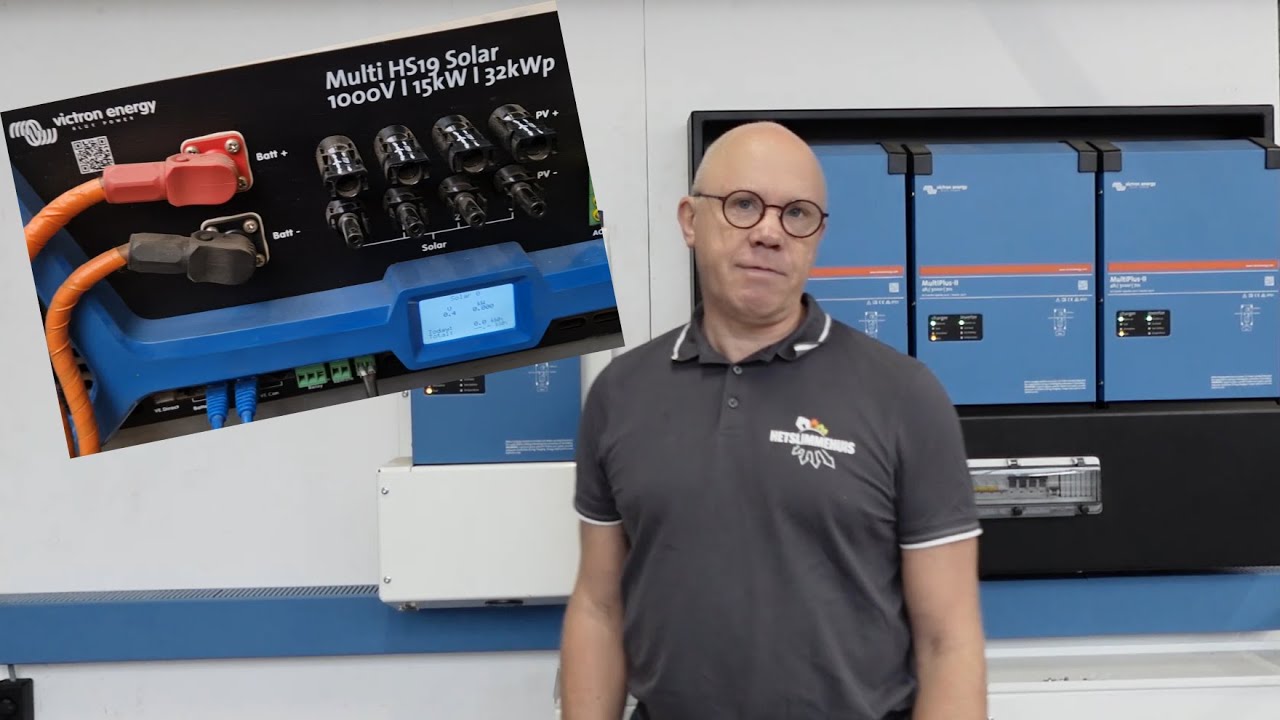
I don’t know the Dutch language or maybe autotranslate is playing tricks…
Aluminium transformer on MP2 4500??? Really???
Hope it’s not talking about the core…
But even if it’s about windings, the electrical conductivity will imply a thicker wire, which will negate up to a point the weight advantage, not to mention the size…
See below, at 4:10.
As a side note, should I understand that HS19 is available, or only some have access to these?
The toroidal core in the Multi/Quattro probably only has a very small magnetic core itself. That won’t account for the weight… The large cross-sections for the secondary circuit are likely to be relatively large and therefore heavy.
Consider the currents used here… so why not use aluminum as well?
Copper is and will become even more expensive… even in vehicle construction, aluminum is now used…
For a long time, the use of aluminum was laughed at… Old Technic from a different era… in the former GDR, a lot of research was done in this area and so-called “ALCU” is used.
A copper-coated aluminum core… No different from copper in terms of processing, but much more sensitive when it comes to damage.
I saw a bit of copper coated aluminum quite a years back in high frequency prototypes. If I recall correctly, the higher frequencies only use the outer layer of the wire anyways, skin effect? Same reasoning around Litz wire.
Then maybe someone could help me understand something…
If you look at the specs and considering the power output, the MP2-4K5 and the MP2-5K have exactly the same power output.
So why will someone will get the MP2-4K5, when the MP2-5K has bigger peak power, bigger charging current, bigger transfer current and wider battery voltage?
More of that, despite what Guy @guystewart said on that video (“with aluminum transformer it’s lighter and it’s cheaper”), the MP2-5K is still cheaper despite it’s copper based… At least here in my country… (4K5 - 1100 euro, 5K - 860 euro)
So?.. Just because it has a slight taller form factor and it’s 8 kilos lighter?
I don’t think the 4k5 and 6k5 “aluminum models” I already took a look inside and it looks like copper windings.
I think that only applies to the 20k model.
Indeed, it could look like copper, but it can easily be mistaken with the CCA (copper-clad aluminum).
For example, a lot of ethernet cables are now CCA. And you can’t say for sure, up until you scratch the wire with a knife and see if it’s still reddish inside or the aluminum silver color is exposed.
For sure you didn’t scratch them…
And the guy in the first post is talking about 4K5. That’s on his wall.
Thanks for that.
Yes… Recommended price. But I suppose Victron can’t control the final retail price.
This was always a problem with distributors here… Only if you insist they start to make a “discount”…
Probably because it’s a new product. Which they also throw like an argument.
Also, in their defense, since a couple of months, here the VAT for green products jumped from 9% to 21%.
Who, knows, maybe they didn’t updated correctly all their prices…
I’ve taken toroidal transformers like the ones Victron use apart, typically the winding depth is no more than 20% of the core height, which would make the cross-sectional area about 50:50 iron and copper because this maximises power – that would make a bit more half the weight (solid) iron and a bit less than half (wound) copper.
However since copper is so expensive it’s common to have a bigger (cheap) iron core with thinner (expensive) copper windings, this increases overall size/weight a little bit but reduces cost significantly for a given power rating. The iron weight is at least 2x (maybe 3x?) the copper weight, allowing for gaps and insulation between the copper winding turns.
There’s no reason they couldn’t use CCA (Copper coated Aluminium) but it needs thicker wires to carry the same current so the cost saving isn’t as big as you might think – also CCA is a bit specialist, enamelled copper wire is made in much bigger volumes so this closes up any cost difference. AFAIK all 50Hz/60Hz toroidal transformers use copper wire, except for a few where weight matters (e.g. in planes) – and these are usually 400Hz anyway so a lot smaller and lighter.
Hey Victron! You guys are watching forum and why there is no official answer in this topic? This is unacceptable to be honest. Clear answer - have you gone cheap using aluminium wires (copper claded, CCA, whatever they call it) or good, reliable, solid copper?
Not sure what more is needed here. It is pretty well discussed.
There are officially some models that have winding as was officially announced elsewhere. So statement has been made.
The market has already been shifting this way so it is nothing new, Eaton APC sStuder to mention a few have already been using aluminium windings for a while with not statical increase in trafo faliures. So it is a field tested method and application.