I would like to introduce myself to this community.
I’m Remco and live in the east of The Netherlands. I’ve just installed and started up our Victron based 48 kWh home system. It’s based on a three phase Multi RS system with two Lynx Power In’s, one Smart BMS 500 and one Lynx Distributor. Power storage is done in three Yixiang battery systems with the JK BMS v19. The house is equipped with a SolarEdge SE9K system with 10.6 kWp of solar power connected to AC-out1.
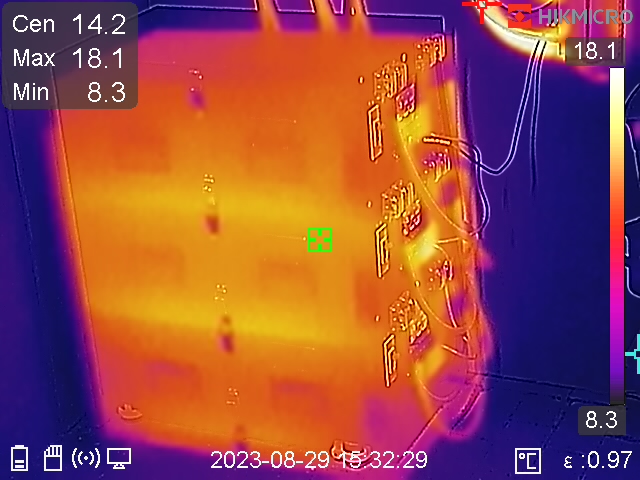
After initial charging and discharge I’ve made IR-heat signature pictures of the system under load and all seems fine. No issues on heat whatsoever. Of course it’s quite cold right now with temperatures around 5 degrees Celcius.
Our entire house is running on AC-out1, but I’m going to change the EV charger to AC-out2 or maybe on AC-IN, since I don’t necessarily want to charge it from battery power. I can schedule the EV charger so it’s also sticking to charging during the cheapest hours.
We’ve been running this system for a few days now and working out the last issues that we’re running into. The JK BMS and Lynx Smart BMS don’t agree on the SoC for example, so I’m rebalancing the system tonight.
Nice.
But what Hikmicro system are you using?
I didn’t see, up until now, a Hikmicro infrared system with such a great misalignment between the optical and thermal image…
I’ve now switched to trusting the Lynx BMS for the battery monitoring. Yesterday after charging to 100% the JK-BMS was on 99% even at 54V, so I don’t trust that anymore. But I need to verify the 100% and 0% SoC settings in both Victron and JK to be able to get it right I guess.
@alexpescaru I’m not sure, I’ve borrowed it from a friend. It was a handheld device but I didn’t write down what kind. It did help me to understand the temperature differences and confirm all seems to be ok.
Thanks for clearing that up.
Curiosity…
As long as the batteries have their own breakers, why not using just some simple Power In modules and went for Class T which are way expensive?
I didn’t want to take any risks here. That’s why I also used the Lynx Smart BMS as a second check on the system, next to the JK-BMS. The t-class fuses are well known and I trust them more than the breakers in the battery boxes. In the total picture the price wasn’t the biggest issue
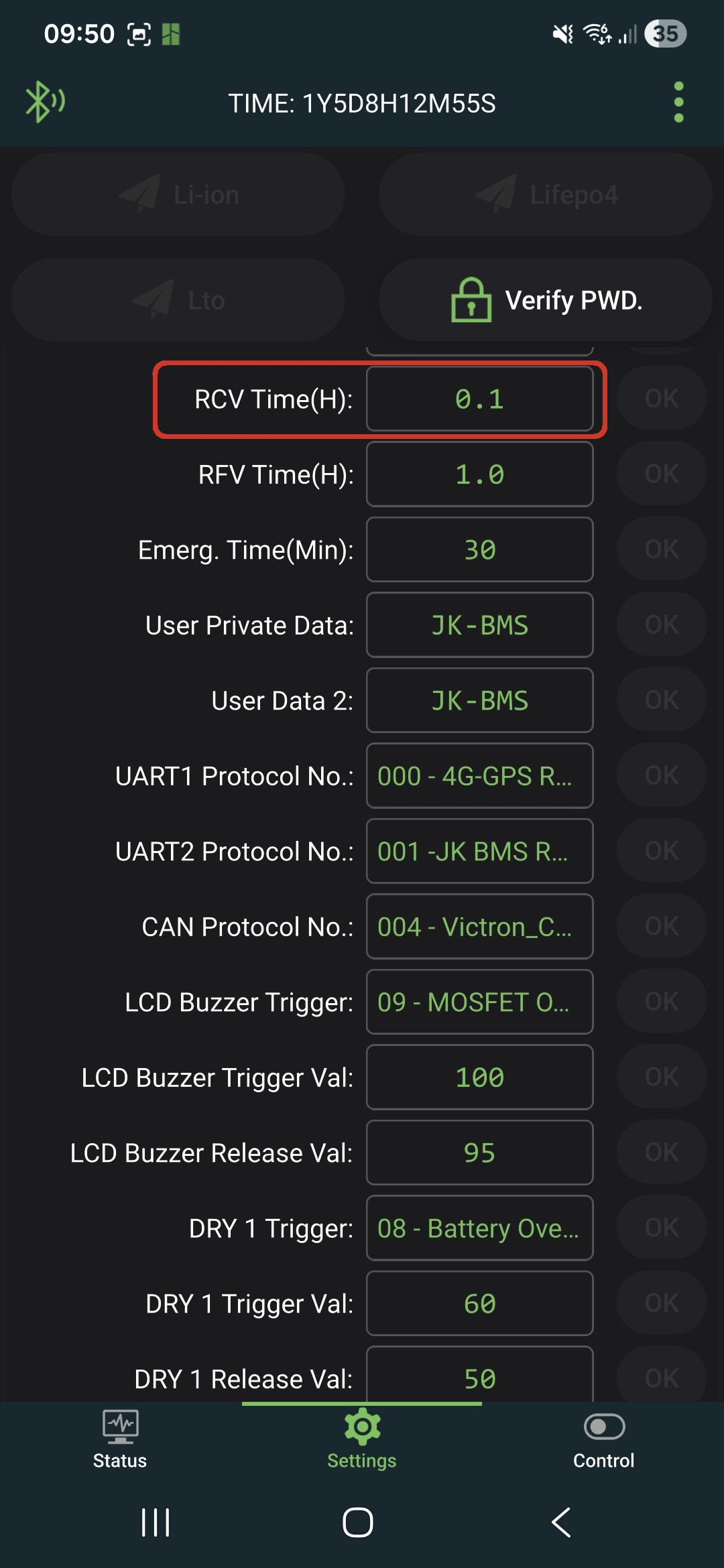
You need to check the JK BMS settings, the JK BMS only goes from 99% to 100% when absorption voltage (SOC-100% Volt) AND absorption time (RCV-Time) is met.
For example: absorption voltage is 55,2V when cell RCV is set at 3,45V. But the voltage has to be at 55,2V or higher for at least 1 hour if you have set the RCV Time to 1h.
My advice would be to NOT use the Lynx Smart BMS, let the JK BMS handle the voltages. If you really want to, you can use a Lynx Shunt or Smart Shunt for more precise SOC values, but from my experience, it should not be necessary. I run 9 batteries with JK BMS without any issues.
The batteries are connected through their own RS485-2 port with their supplied UTP cables. With the dip-switches set the id’s correct so they all have their own ID. the dip switches are binary: so id 0 is all off, id 1 is the first one up, id2 is only the second up, etc. Then connect the master box with the type A cable to the Victron Cerbo on it’s own canbus (500 bit). That’s what I did and worked immediately.
@vaursechs Thanks for the settings, I will check them this evening. I watched the off-grid-garage video’s and he showed the issues with SoC on the JK bms. However if the voltage readings are correct then I can trust that BMS as well.
I follow Andy as well, but in my setup, the SOC status of the JK BMS seems much more accurate than on his system. Not sure why, perhaps it is because I cycle my batteries much heavier.
Using T-Class fuses is smart. All those breakers are way too slow and/or overrated, and because of that you may damage your cells.
Let’s take the EVE MB31 cells with a maximum discharge capacity of 157A at 25°C. Here comes Johnny DIY battery box vendor with a 250A breaker. Yeah. Bad idea.
This is also why my battery wiring is fused at a higher rate than my battery boxes. I won’t go over 125A for said prismatic cells.
I did read about the heating but didn’t know it would have such an impact on the State of health of those batteries. I wanted to keep them warm because I will warm them through charging anyway, but not sure if that is maintainable… Do you have any suggestions that I could look at, after I have already built the boxes?
Yes true, that’s why I have three boxes with space for at least one more If needed I could place 4 more.
They’re Yixiang boxes, v2 with v19 BMS.
We have some Dutch suppliers that have them in stock and ship in days. I prefer that with some more support but a higher price. So that depends on what you prefer or options that you have.
A short circuit is officially not allowed/supported. EVE did test it for 10 minutes, but that also means the end-off-life for the cell.
And while you could use Ohms law to do your own calculation I strongly advise everyone to just prevent a short circuit and not to use damaged cells. The latter can potentially cause some internal short circuit in the cell. I’ve witnessed it from a close distance and it was shocking brutal.
That heavily depends on the budget. There are several options. From (silicone) heating pads to foil pads. External heating is another option. Your supplier should have some for sale.
I personally use a diesel generator for off-grid and we use the exhaust heat to warm up the batteries.
Returning to my post about connecting multiple batteries in parallel..
In the “energy storage “ section of the American ‘ diy solar forum’ , many report (in many topics) that it’s not possible to connect multiple batteries in parallel with jk v19 bms, (bug).
Attempts to update the Jk v19 bms via a PC only result in a bricked bms.
So far, no solution has been found on that forum.
You prove that’s it’s possible without any problems.
Remco, what are your UART settings?, those from Nick Ebben are no longer valid.