Multiplus II in ESS not inverting

Solved.

Low battery alarms disable discharge (not always though).

These are triggered by ESS.

Threshold are given next to the discharge C ratings in ESS.

Setting voltages accordingly did the trick.

Hello,

I hope someone can help. Spent days in config and stuff. So much legacy and quirks around.

What Do I have:
VenusOS 3.66
MQTT Battery
MQTT Grid
MP II 5000 latest fw.
DIY Battery NCM chemistry 40-55V. ESPhome BMS.

MP is configured as ESS with lead acid battery. No matter what other type I use I get LowBattery Alarm just always. With this config it goes down to LowBatt warning.
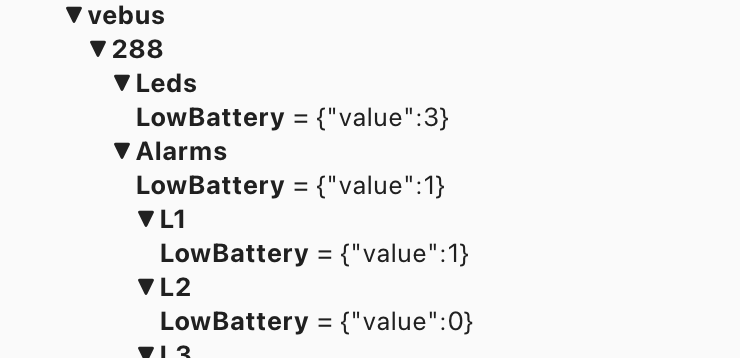
Low Battery should reflect the VE config settings an DVCC current limits. But none are close to thresholds.

DVCC is enabled and used:

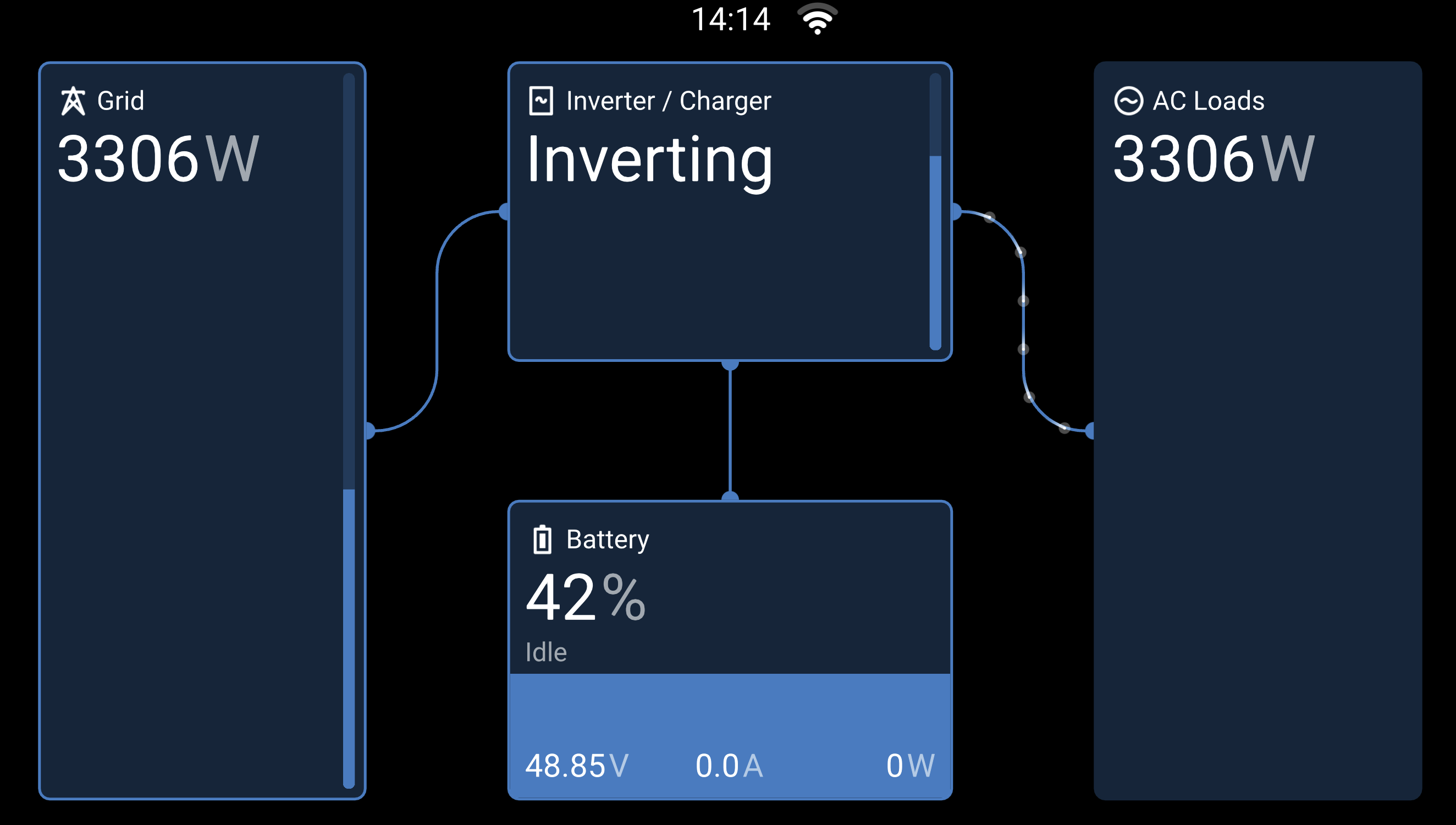
Venus OS and VRM display the battery and grid as implemented:
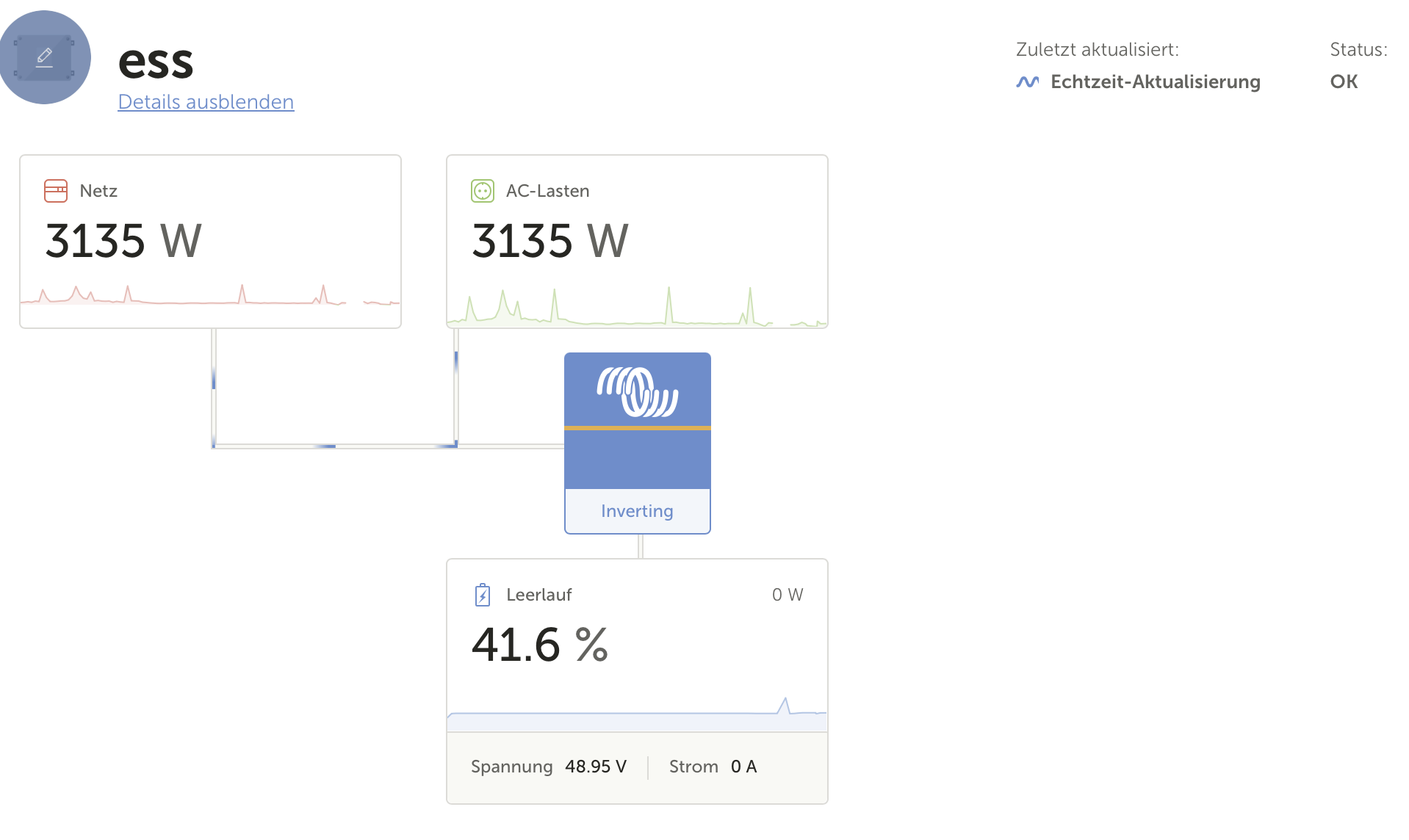
A little odd: the v2 gui believes the inverter is supplying the full load:
So, What is working:

Setting ESS to “keep batteries charged” does the right thing. limiting charge current to battery limit. all doing great
When MP is factory reset to non grid default without assistants it is doing charge and discharge full power.

what not:
Any inverting beyond MP self supply is not working.
I do only see one limit preventing a discharge
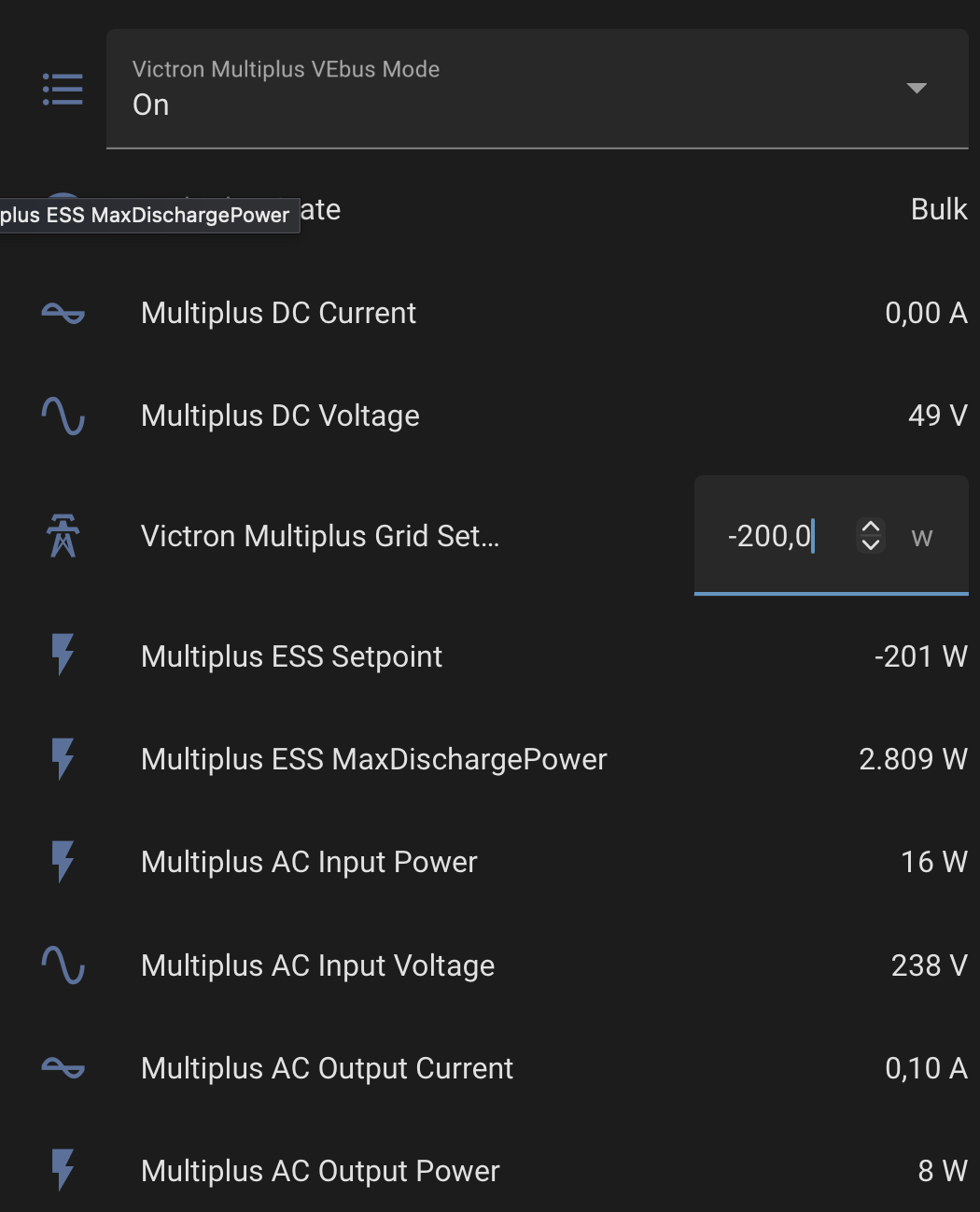
besides: victron/N/123/hub4/0/MaxDischargePower: {“value”:79.21800247192382}
However no clue to set this, overriding seems not possible. It is recalculated very often and changes in small amounts. Probably this is unused legacy. Other relevant state can be set in UI and MQTT.

With so much legacy floating around on dbus MQTT. Which values are the ones to care? Hub4? CGwacs?

After a digging fĂĽrther: I guess this is related to:
victron/N/2ccf67cc3f47/hub4/0/MaxDischargePower

I managed to get this above 100W. however the underlying voltage to calculate that values seems a fixed 48V. At least power output and value of maxdishargepower are exactly same at 48V

At same times the grid set point is really used. but no way consistency. and the grid itself is not used at all.

Would be great, if someone has the magic tip.

cheers
Jan
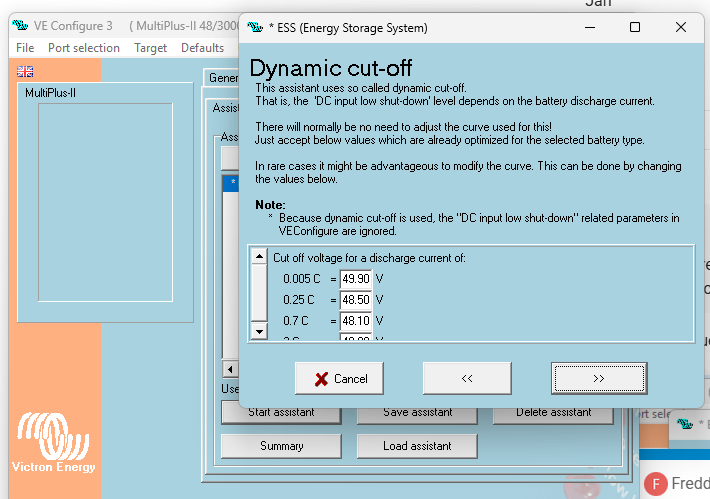
What are the values in ESS assistant (Dynamic cut-off)

1 Like

Hi Fredd,

Thanks for investigating.
I set these to 55 ±1V . This should be related to charging only. My problem is discharging.

Do you know, if lowBatt warnings are cosmetic?

And I spent another day and figured out, the DVCC Battery control seems to matter in regard of maxDischargePower. As voltage is not providable its on currents.
I have 4 battery blocks, each separate switchable. Each block contributes to max 20A, but only if activated.
The possible current influences the Maxdischarge Power. no surprise. however, it just does not fit. maybe the internal resistance assumptions are off.

55 Volt?

What battery have you.

My battery is a 16S LFP (51.2 Volt)

Dynamic cut-of is for discharging

For charging

1 Like

I have NCM chemistry. 4.2*13 =54.6

The current is calculated on SOC so I do not need voltage drop off stuff

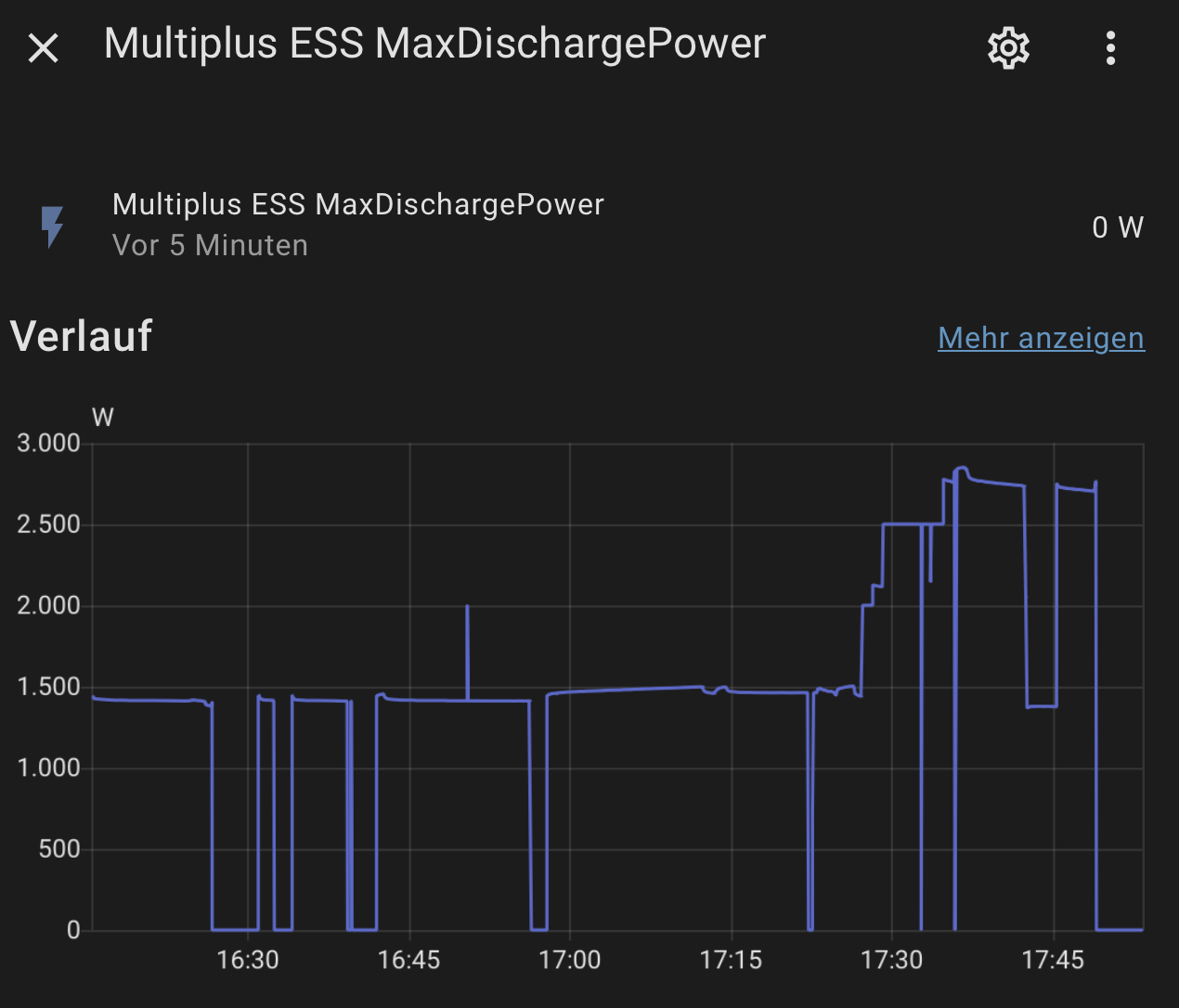
The MaxDischarge power ist the trouble:

When I switch the inverter off, this goes to zero. Unfortunately it does not come back! Turning on it stays at zero. After Charging with a lot of power ist appears again. So strange.

what’s more, it is sometimes stuck in charging, And can not switch to discharging:

DOOOH

these are LOW CutOFF values:

these determine the low batterie thresholds.

As a LiIon Developer since 15 years I could never imagine a C rating limit on discharge! This is from the old lead acid ages.

So many legacy quirks here. But in the end: RTFM. Read the f#cking manual.

I have LFP battery and my battery can 0.5 C en some other can 1 C

The minimum (cut-off) LFP battery is 2.5 Volt x 16 = 40 Volt.

Your voltage 48.85 Volt and your cut-off value is (was) 55 Volt so it stops at 55 Volt discharging.

Have you change the cut-off values?

My battery is a bit different.

3V is 0% SOC,

4.2 is 100%

Yes, I changed the cutoff values all to something like 41.2 V, which is the lowest accepted.

My 3.0V *13=39 V is not possible. At 41.2 Volts, 2C or 100A are no problem; the battery is not the limiting factor . These settings in the age of LiIon batteries should not be used.

It’s a bummer; the BMS can send current and upper voltage limits. Lower voltage limits are configured in ESS with corresponding C rates. That’s quirky and probably heritage stuff.

Now, this is doing discharges as expected. I was on the wrong track, as discharging with the wrong settings was possible! Probably some not-so-well-documented algorithm is allowing discharging at special situations.

This topic was automatically closed 14 days after the last reply. New replies are no longer allowed.