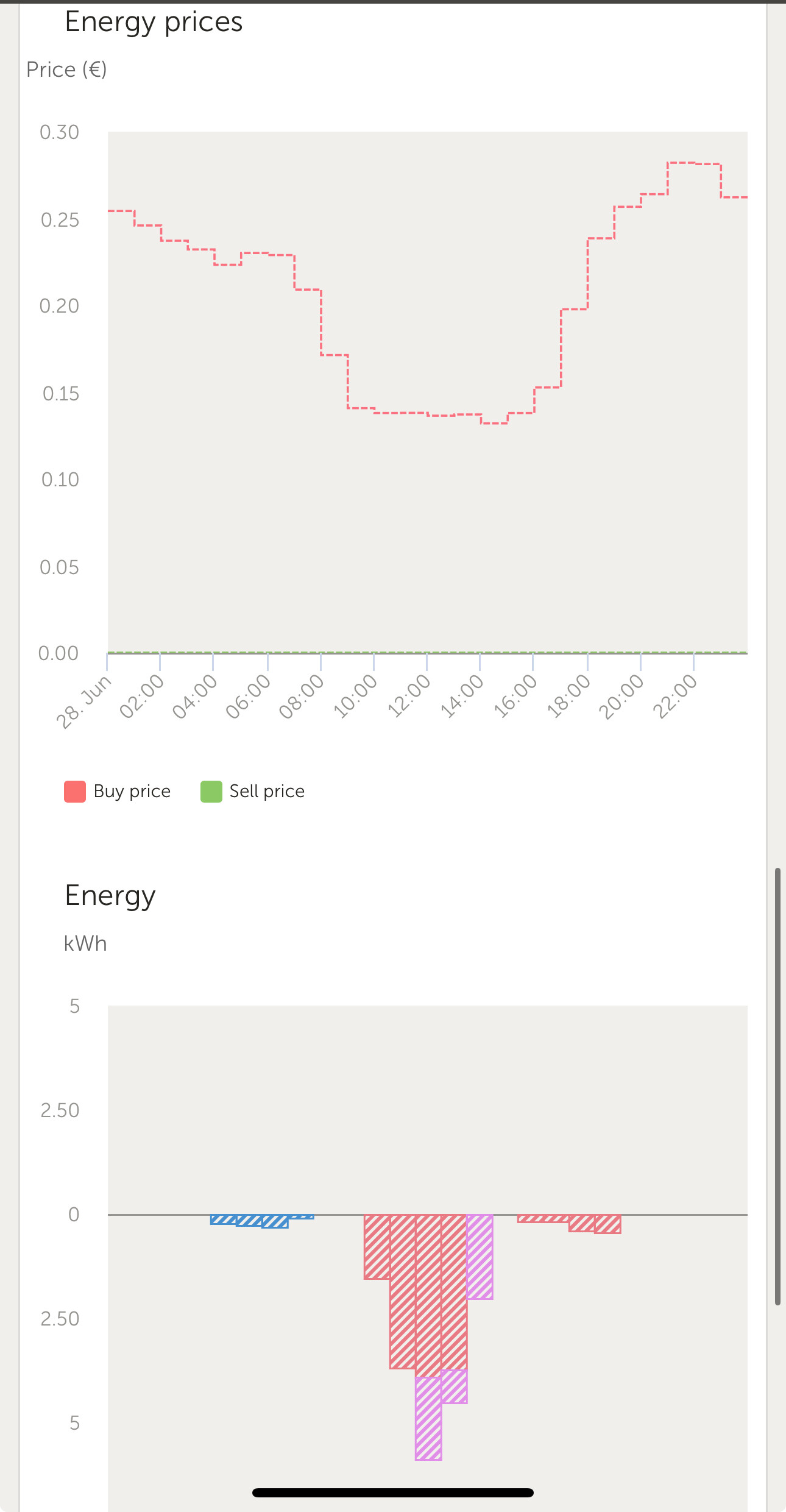
Thanks, @dognose – this is really useful information and I appreciate you sharing it with everyone. Knowing what to expect is half the challenge, so at least now I can implement a workaround as suggested by @motylu.
I appreciate there’s a bit of work involved in working on that root mechanics, but I hope the team stays the course – DESS is a great concept and it’ll only provide more value to customers as it matures.
Thank you for those graphs – that’s really useful information. I take it what you’re showing is information only available to you on the VRM backend?
I’ve checked off BMS (requesting ≤ 190A CCA, 55.2V CVL), DVCC appears correctly configured and Peak Shaving - is set to “Above minimum SoC” – I don’t have it configured per se. I do notice a voltage drop on AC-IN with higher loads (230V → 215V – it’s at the end of the long line) but it doesn’t seem to be generating any errors. I cannot 100% confirm the temperature being an issue with the Multi itself, but the battery is reporting temps of 24º-27º across the packs and they’re living in a room with an ambient of about 15º right now. I feel like thermal throttling shouldn’t be an issue.
I should add that the system is quite happy to discharge at much higher rates, very happy to push 10kW out of the batteries if requested. It seems like the issue only occurs on charge.
Can you suggest how where I might look for more diagnostics?
You could probably turn of DESS, when you have a battery capable of full charge and check two things:
What happens when you set a grid-setpoint of 8000 + consumption, when there is no Solar? (Expectation is, Battery should be charged at maximum rate from grid)
What happens when you set a grid-setpoint of 8000 + consumption, while there is Solar? (Expectation is, Battery should be charged at maximum rate, but only what is missing from Solar should be pulled from grid)
So, this would just verify, that there is nothing “blocking” 8000 Watts beeing send from grid to battery.
Generally, having 10 kVA attached to a single phase while having the other phases “unmanaged” may have something to do with it, just have to figure out if that’s a general Issue (Tests without DESS) or if some other “Limit validation” does something not ideal here.
That is all data you could also look at on dbus (using dbus-spy) or your gxs mqtt. (For example /system/0/DynamicEss/ChargeRate would be the yellow line - the chargerate DESS is basically calculating for the current moment and requesting from the inverter.)
In gui V2, you can also find all variables in the Debug->Values Section, if you don’t have ssh / mqtt access:
Practical question: where do you set that in Node-RED? And related: to what setting maps the ‘Gateway - DESS Charge Rate (W)’ of the VRM Advanced page graphs?
I’m afraid I can’t answer any of these. Not using Nodered and the debug Menu was always visible since I own a cerbo, never did some special settings, I think.
The chargerate doesn’t map to any setting, it’s not a writeable setting, just an output of what is calculated and requested from the inverter(s)
Hello, my victron is randomly forecasting zero energy usage in the night, I never had 0 kwh any hour since the system is live.
Is there any solution for this, anything I can do?
Thanks
That is a bit of a mystery, could it be related to a debug setting on the cerbo itself? I never got round to ssh-ing into the cerbo (MP-II GX), other than running Venus OS large in beta it’s unmodified.
It involves going to the General Settings page, with the top ‘Access level’ row (probably says User & Installer) selected and then pressing & holding the right button (GUI v1 remote console).
In GUI v2 you need to enter the Access level menu and press & hold the right arrow on your keyboard.
By way of follow-up – I’ve been tearing my hair out every time I’ve tried to work this out, and finally thought I’d upgrade the firmware on the Multis to v556… Problem solved, charging at full capacity of the AC-IN limit.
But I’ve had a good learning journey diving into D-Bus and other things
Hi Auke, I think I have the same issue, and a similar configuration. I have been googling and checking quite some threads, but until now I did not find a correct and hopefully easy solution, to switch off the Smartsolar RS 450/100 during negative prices. I see all kinds of solutions like HA or NodeRed, but I was hoping that there would be just a setting (by now) somewhere in DESS.
So, now a year after your post, did you manage to solve this issue?
Thanks! Mark.
Yes, I installed more batteries. The batteries now can not be fully charged in the short time the prices are negative. So, it is no problem the PV is helping to charge them in that period.
I also have a large battery that cannot be fully charged during negative energy prices, but I would really like a solution to be developed that allows you to configure SolarEdge via Modbus to pause charging. I have three MP2-5000s and would like to see the charging capacity fully utilized based on grid consumption. This is to maximize the benefits of the price gains and avoid unnecessarily burdening SolarEdge during these times. And I would like the scheduling to be adjusted accordingly. I hope a solution is found soon.
Great, sounds really good! Question (or idea), how will this be implemented?
I see two options:
Hard switch off all solar
Dynamic curtailing based on maximising grid import, though still maximise charging of the battery. This would enable for example still charging of car / run heatpump in parallel of battery charging.
The latter would be the fancy option maximising financial benefit.
Please also consider if you are able to provide mqtt / modbusTCP accessible information that DESS wants to block solar. I do not have Victron MPPTs yet but it would be super easy to periodically check via MQTT or modbusTCP whether solar should be blocked, and then do it.