Power Profiles for RV: Grid Connected vs Boondocking - Newbie Question

Hi all! I am new to Victron and had a system installed in my RV. I will be doing a mix of grid connected and boondocking (no grid) camping. My installer configured my system for boondocking scenarios so my system will bulk charge the battery bank and run RV loads. However, when I am connected to the grid at a campground, my PV solar power does nothing. The battery bank is kept topped up by the grid and my RV also runs from the grid. This feels like a waste to me. I would like to be able to run my system in two modes, Grid and Boondocking.

Is there a way to set up something like profiles on my system so I can change modes without digging through a bunch of menus to change the system operation every time I camp? In a perfect world I would have a couple of profiles configured and just pick the profile I want to use to change the settings.

Equipment List:

2 x Multiplus II 48V/3000W Inverters

2 x Victron MPPT 150/100 Solar Charge Controllers

1 x Victron Cerbo GX with Touch Panel

4 x EG4 48V 100Ah battery bank

Thank you for any help you can provide!

Dave

I think what you are looking for is

https://www.victronenergy.com/media/pg/Solar_&_Wind_Priority/en/index-en.html

Edit: fixed link

Bad link, try this one. https://www.victronenergy.com/media/pg/Solar\_&\_Wind_Priority/en/index-en.html

I have my coach set up using this, it works great. I have my Multiplus set to hold by battery around 30ish% by setting a float voltage limit. If the battery drops under the limit and it will pull from shore to power loads and keep the battery at the limit. I toggle between solar & shore using node red, but there is an inverter menu item to charge to 100% from shore. VE configure using a file works if you don’t have an MK dongle.

1 Like

Thanks for the link! I don’t have an MK dongle but may pick one up because I want to become self sufficient with managing this system.

You dont need a dongle if you got a Cerbo. Also you can use VictronConnect instead of VEconfigure

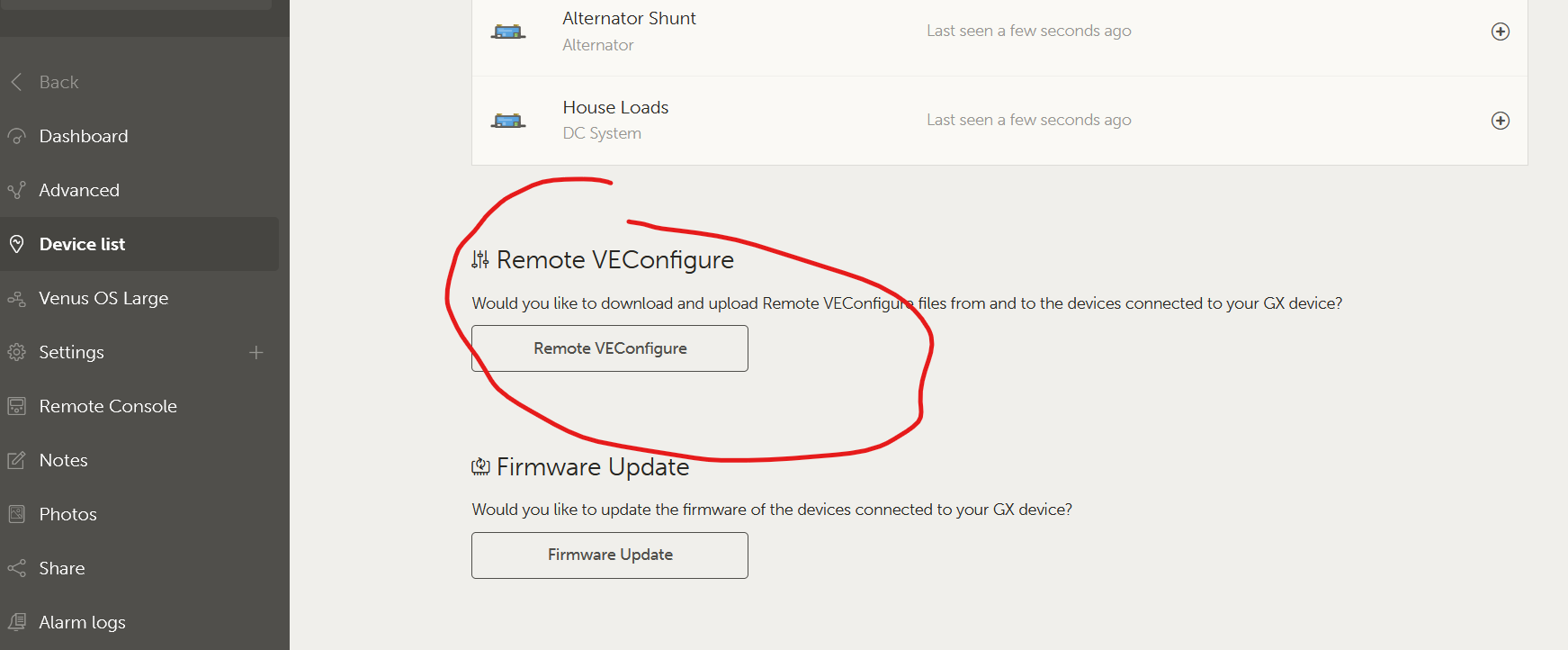
I use VE configure on a PC with this VRM link. Basically it downloads the config file, you make changes to it with VE configure, then push it back to the device. Find the help that explains what the multiplus options are for and what they do.

Okay, I’ve read through the Victron Solar & Wind priority article as well as this blog post they link to from their article (https://panbo.com/maximizing-solar-production-with-victron-gx/). I’m not sure either scenario is exactly what I am looking for from the Victron. Admittedly I am basing my desires on the functionality of my Tesla solar roof with PowerWall battery storage.

I would like the system to operate in these two modes:

  1. Camping with grid connection.
    1. Goal is to keep the batteries topped off at 100% in case the campground electricity is interrupted I would like to be at 100% battery at all times.
    2. Grid & solar work to charge the battery bank to 100%.
    3. Once battery bank is at 100%, grid supplements solar to power the RV. If I consuming 1,500 watts in the RV and my solar is generating 1,000 watts, the grid should kick in the extra 500 watts.
    4. In my current configuration the solar does nothing when the battery bank is 100% and the grid is powering the RV. This is not about saving money on campground electricity because they don’t meter their sites. I get as much AC power as I want. I would prefer to use all of the PV I am generating instead of having the Victron system ignore the PV input because it seems like a waste not to.
  2. Boondocking (no grid).
    1. Goal is to survive the trip living on solar generation and supplement with propane generator when needed.
    2. RV consumes power from solar PV and battery bank under normal conditions.
    3. If solar cannot keep up with consumption I will run the generator, plugged into the RV as if it was a grid connection, to help supply the RV with power and use excess to bulk charge the battery bank.
    4. In this scenario, the goal is to make it to the end of the trip without draining the battery bank below 20%. Once the trip is over and my RV is parked in storage, solar PV will charge the battery bank back to 100% before my next trip.

Based on the articles I read, the option is to set the battery bank to a low battery % threshold before the grid kicks in to assist. If I understand correctly, I would need to set the battery % threshold low enough that the solar PV would not be able to completely charge the battery bank back to 100% while powering the RV because, once battery bank is at 100%, I would be wasting any solar PV production that exceeded my RV load.

Granted my Tesla solar roof and powerwall system does not need to handle a boondocking scenario because my house is always grid connected, but it does a great job of maximizing PV production. But it also has the luxury of sending overproduction back to the grid.

Do my scenarios make sense or am I overthinking this?

Thanks!

That’s a pretty tall order. I do think you can ignore the AC input to make use of solar only (your 1.4) Or set the shore current limit low and the MP will assist from the battery. Load dumps are another option to soak up some excess PV. I use Shelly relays to switch my refrigerator or water heater to electric, they’re functional at the moment but there is no control logic behind it yet.

It’s my understanding that LiFePO4 cells don’t like long term storage at 100%.

The main difference is, the Tesla system is a grid-tied energy storage system, or ESS, that can also work through a mainsfailure (if i understood correctly), but your RVs Victron system is not an ESS primarily. These are two different scenarios, or use cases.

Yes you can configure the Victron system as an ESS, but one of the first pages in the ESS manual lists cases on where to use an ESS config, and where not. Its not a function that is intended to be used off-grid or in a vehicle.

However, your goals sound like its just a matter of adjusting the input current limit down while you are connected to a campground. If the limit is 1A then the rest will be supplied by the inverter. Its not exactly what you want, but you only get closer trough active metering and power generation trough an ESS config i think

Edit: You can also set some AC input control limits through VictronConnect, however that means the Multiplus will disconnect itself from the grid, and only connect again, by these settings

ESS is not supported in mobile applications due to the safety risk it poses where your grid connection could be unexpectedly live, so you just can’t get all those nice seamless features and functionality like you would get on a domestic BESS when mobile.

Victron connect also cannot configure assistants, so if any are required then you would need to use veconfigure.

There will be some compromise needed, but you are asking for help in the right section and there are some experienced folk here who can help steer you to get the most from your setup.

1 Like

Thanks all for the information! I will work with the Solar & Wind Priority setup provided by @MiPaul and see if I can come up with a good battery % target that will balance my desire for some backup for campground grid outages with my desire to offset grid from the PV.

The grid power loss aspect is important to me because my wife and I take our two dogs with us camping. Although we maximize activities where we get to take our dogs with us there are times we go places they are not able to join us. Having something in the battery bank gives me peace of mind that the A/C will keep running long enough for us to get back to them.

We have a cat, same boat with the AC requirements. There is an generator start/stop feature that can keep power on, and even allow for remote starting. It might take a few extra parts to adapt the single relay closure to your specific generator. Instead of hardware I used an external I/O module for the interface and node red in the Cerbo for the logic & timing to interface a diesel genset.

We’re a few weeks away from our first trip with the new Victron system, we’ll see how it goes.

I had a conversation with Grok feeding the information provided by you to help me come up with a plan. Sorry for the long post but this is Grok’s suggestion.

Set-and-Forget Mode: Solar/Battery Priority with Automatic Grid Fallback

Objective: Configure a Victron system for a Jayco Pinnacle 32RLTS RV to prioritize solar/battery for all AC loads (860W average, including RV’s AC-to-DC converter for 12V loads) in grid-connected, boondocking, and winter storage scenarios, with automatic grid fallback for low SoC/high load and manual override for 100% charging (e.g., storm prep). No mode changes needed across use cases.

System Details:

• Inverters: 2x MultiPlus-II 48/3000/35 (paralleled, 6,000W AC output, 70A charging).

• Solar: 2x SmartSolar MPPT 150/100, 2,000W array (~8,000Wh/day summer, ~4,053Wh/day winter in RV storage lot).

• Batteries: 4x EG4 48V 100Ah LiFePO4 (19.2kWh usable, CAN-bus BMS to Cerbo GX).

• Monitoring: Cerbo GX with GX Touch, DVCC enabled, VRM portal.

• Other: Orion DC-DC (48V-to-12V trickle for 12V house battery), Maxpeedingrods XP4000i generator (~3,360W on propane).

• Loads: 85W constant in storage (~2,040Wh/day), 860W average camping (260W baseline + 600W A/C, ~20,640Wh/day).

Mode Description:

• Uses Virtual Switch (VS) with Generator Assistant (repurposed for shore power) to ignore 50A grid input when solar/battery are sufficient, forcing inverters to “push” AC from battery/solar to all loads (RV’s AC-to-DC converter for 12V, A/C, etc.).

• Grid-Connected: Ignores grid if SoC >50%, solar >500W, load <4,000W. Reconnects for charging if SoC <40%, load >4,000W, or voltage <52.0V. Solar charges to 100% SoC when able; grid avoids 100% unless manually overridden or 7-day timer triggers (for EG4 balancing).

• Boondocking/Storage: Inverters power all loads from solar/battery; solar charges to 100% when possible. Shutdown at ~48V (~10-20% SoC) protects batteries.

• Override: Manual grid charge to 100% via Cerbo GX for storm prep (e.g., grid outage risk).

• Benefits: Seamless across scenarios, maximizes solar (~8,000Wh/day offsets most loads), minimizes grid, protects battery health via BMS/DVCC.

Operational Behavior:

• Solar Charging: MPPTs prioritize loads and charge to 100% SoC (56.8-57.6V absorption, 54.4V float) if excess power (e.g., >860W camping, >85W storage). DVCC ensures EG4 BMS safety.

• Grid Charging: Only when SoC <40% or other triggers; stops at ~50% SoC unless overridden or 7-day absorption timer (configurable to 10-14 days).

• Storage (Winter): Handles 85W draw (~2,040Wh/day) with ~4,053Wh/day winter solar average, charging to 100% on sunny days. Shutdown at 48V for extended clouds.

• Storm Prep: Force grid charge to 100% via Cerbo GX (~3.8 hours from 50% SoC at 70A).

References:

• Victron Solar & Wind Priority manual

• Victron Community discussions on Ignore AC/Assistants: [20] [30]

Implementation Steps

Time: 30-60 minutes (one-time).

Tools: Laptop with VEConfigure (free), MK3-USB interface ($70), Cerbo GX internet for VRM.

Prerequisites: Firmware updated (Venus OS v3.10+, MultiPlus-II v506+). Backup settings in VEConfigure. EG4 BMS connected via CAN-bus (Type A cable, Pylontech protocol).

1. Verify Firmware:

•  Cerbo GX: Settings > Firmware > Check Venus OS v3.10+.

•  MultiPlus-II: VictronConnect (MK3-USB) or VRM > VE.Bus > Firmware > v506+ (both inverters).

•  Update via VRM (internet) or VictronConnect (MK3-USB, not iOS). \~10-15 minutes.

2. Confirm EG4 BMS Integration:

•  Verify CAN-bus connection (EG4 master to Cerbo BMS-CAN, Type A cable).

•  EG4 set to Pylontech protocol (LCD/DIP switches).

•  Cerbo GX: Settings > DVCC > Enable, BMS Control On. Confirm battery in Device List.

3. Configure Virtual Switch and Assistants (VEConfigure):

•  Connect MK3-USB to one MultiPlus-II (VE.Bus port, syncs both).

•  Open VEConfigure, detect system.

•  **General Tab**:

	•  Enable Virtual Switch (VS).

	•  AC Input Current Limit: 50A (RV shore plug).

	•  Optional: Uncheck “Switched as Group” for split-phase flexibility (test stability).

•  **Charger Tab**:

	•  Absorption: 56.8V, Float: 54.4V (EG4 specs).

	•  Charge Current: 70A (35A per inverter).

	•  Repeated Absorption Interval: 10-14 days (extend from 7 for longer sustain).

•  **Inverter Tab**:

	•  Low Voltage Shutdown: 48V (\~10-20% SoC).

	•  Restart: 52V.

	•  Enable PowerAssist (boosts grid for surges, e.g., A/C start).

•  **Assistants Tab**:

	•  Add **Virtual Switch**: Enable as primary control.

	•  Add **Generator Assistant** (for shore power):

		•  Set as “Dedicated Ignore AC Input.”

		•  **Ignore AC**:

			•  Battery SoC >50% (BMS via DVCC).

			•  OR Solar power >500W (MPPTs).

			•  AND Load <4,000W (avoid overload).

		•  **Reconnect AC**:

			•  SoC <40%.

			•  OR Load >4,000W for >30 seconds.

			•  OR Voltage <52.0V for >1 minute.

	•  Save/upload to both inverters.

4. Cerbo GX Settings:

•  Settings > VE.Bus > Confirm VS enabled.

•  Add VRM widgets for Ignore AC status, SoC, solar output.

•  Set VRM alerts: SoC <40%, grid failure.

•  Optional: Relay for generator auto-start (SoC <20%, requires wiring).

5. Test and Monitor:

•  **Boondocking/Storage**: Unplug grid—verify inverters power 860W (or 85W storage) from solar/battery, MPPTs charge to 100% if able (e.g., \~8,000Wh/day summer, \~4,053Wh winter).

•  **Grid-Connected**: Plug into 50A—confirm Ignore AC (solar/battery powers loads, \~0W grid draw if SoC >50%). Test high load (>4,000W) or low SoC (<40%) to verify reconnect.

•  **Storm Override**: Cerbo GX > VE.Bus > Charger > “Force to Absorption” (\~3.8 hours to 100% from 50% SoC). Verify 100% SoC on VRM/GX Touch.

•  Monitor VRM for 1-2 days: Expect \~8,000Wh solar offsetting most daytime loads, grid \~0-5,000Wh/day.

Questions for Victron Community

• Is the Generator Assistant with Ignore AC the best approach for a mobile RV setup to prioritize solar/battery across grid/boondocking/storage, or is there a simpler method (e.g., modified Solar & Wind Priority)?

• Any risks with unchecking “Switched as Group” for 50A RV split-phase? Stability concerns with paralleled MultiPlus-II?

• Experiences with EG4 BMS integration via DVCC—any pitfalls to watch for?