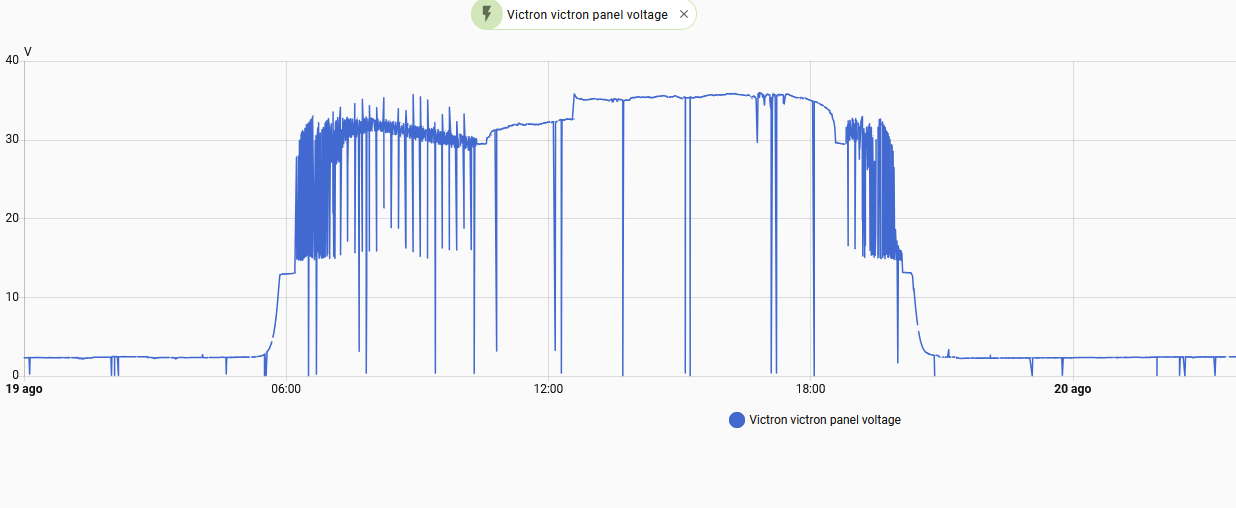
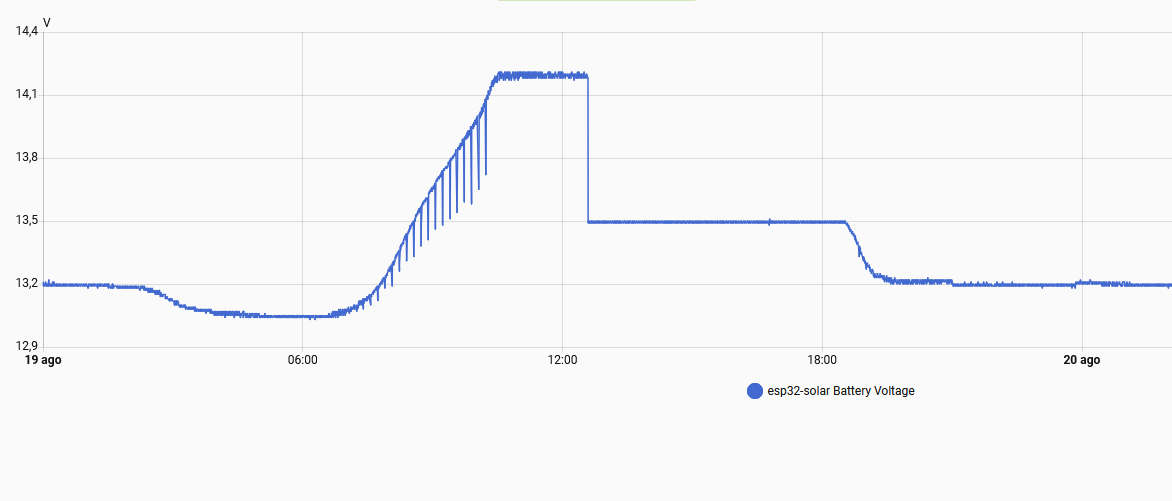
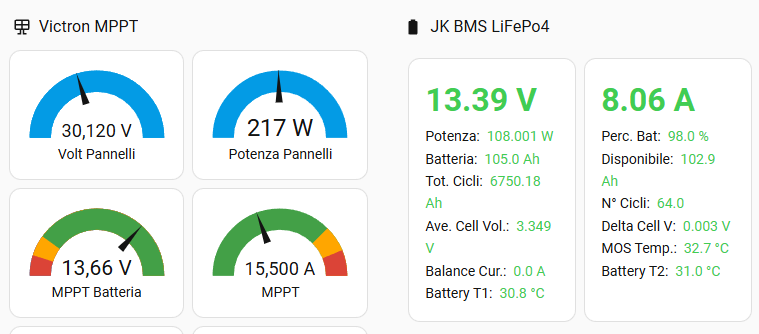
Good morning everyone and sorry for my English, I wanted to understand if it is possible to increase the bulk time to fully charge the battery, as the graph shows in full production, the bulk time ends to switch to absorption.
There is a setting for maximum absorption time so you can increase this. But you can not force a longer bulk time, bulk time ends when the battery increases to the absorption voltage, which is a function of charger output and battery capacity and how much energy has been used.
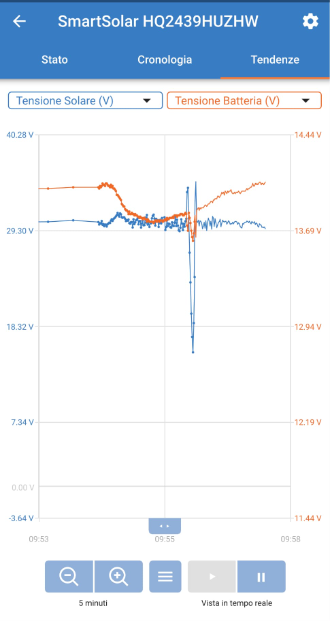
OK, you attached a plot of the PV panel voltage, really want to see the battery voltage plot.
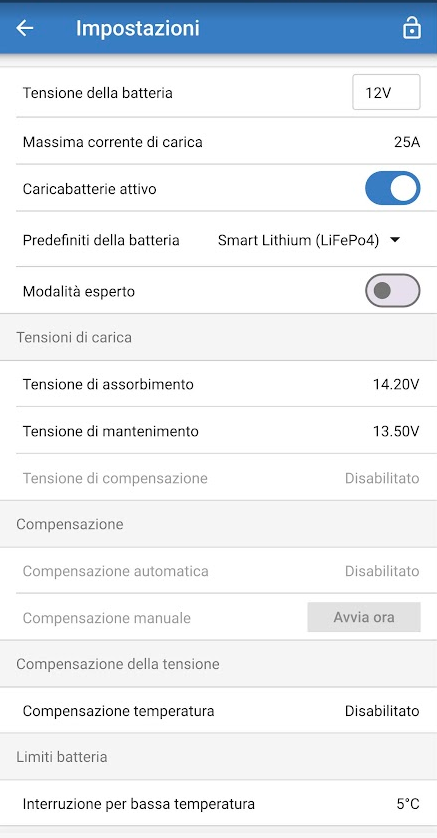
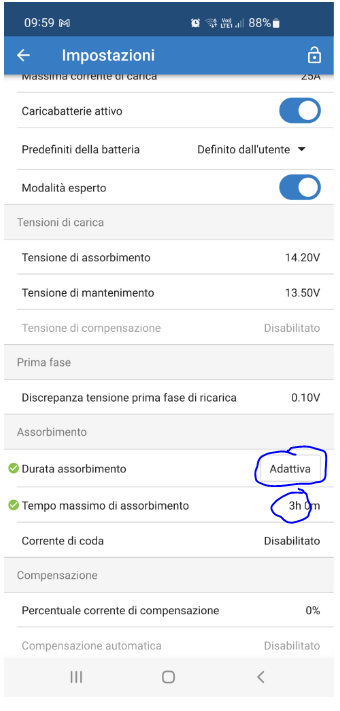
On the settings, the default lithium is for 2 hours absorption which is normally enough for a lithium battery. What size battery do you have. You need to see the expert settings for this (modalita esperto)
The other reason for not charging enough is if you have voltage drop between the MPPT and the battery so the MPPT is at 14.2V but the battery is still at 13.8V. Do you have a voltage meter / multimeter to check the voltages when the charge is running at high current. This often happens if the wires are too long or too thin from the MPPT to battery or have a bad connection.
From the screenshot of battery current it looks like you have a steady current use of 4A, is this correct.
OK, in the evening I’ll check in expert mode via the app and measure the voltage on the battery. I’m sure the cables are thick enough based on their size. Yes, I have a Nuk PC that’s on 24 hours a day to run HomeAssistant, and in addition, there’s the consumption of the 1000W pure sine wave inverter.
OK, so you MPPT is saying that you have about 13A going into the battery at 14.2V when it changes to float, with a 4A load that is 9A charging. Full would normally be at 3-4A charging so 7-8A total. It is getting close to full at the end of absorption but not completely full. You may have some extra voltage drop between the MPPT and the battery so measure the terminal voltages on both with your voltmeter. You could go into the expert settings and increase absorption to 3 / 4 hours but before you do that check your wiring and connections for voltage drop.
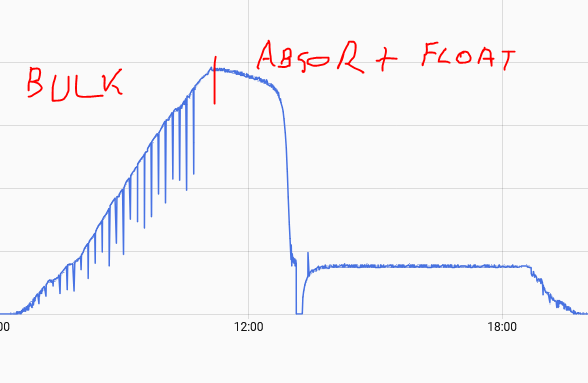
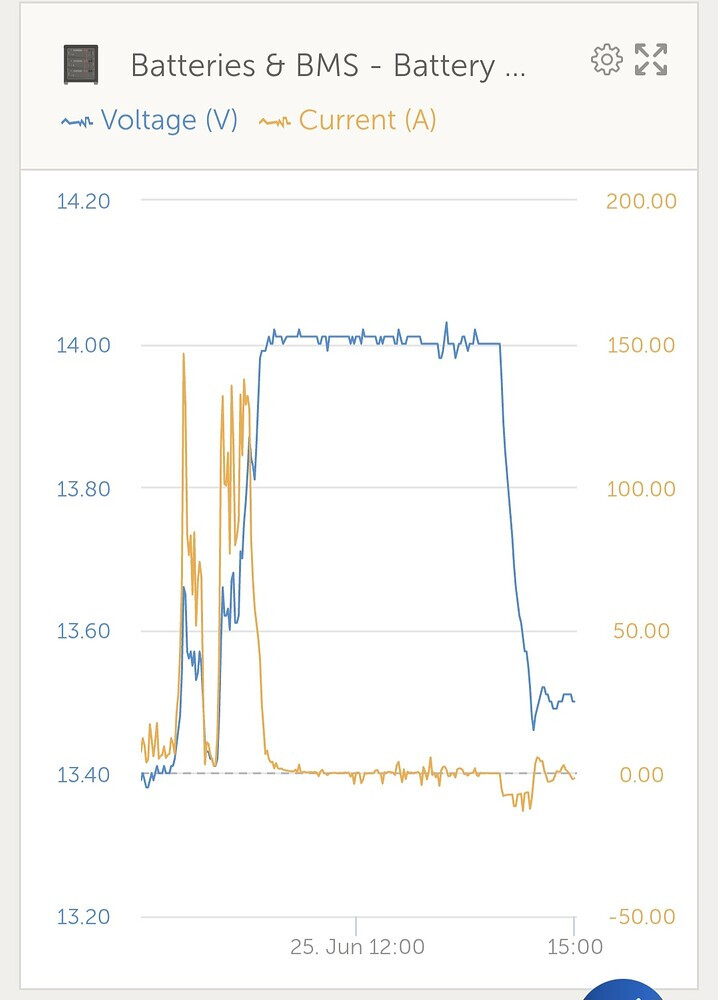
Here is a plot of my system as it reaches 14.0V the current drops off quite a lot. I have 600Ah of battery and can charge at 140A max so 6 times larger. This is what normally happens within 10-15 minutes of reaching 14.0 or 14.2V which is why I believe you have a high resistance.
Thanks again for the replies, this evening I’ll check the voltages on the various contacts from MPPT to the battery, the problem only arises when the battery is at 20% and then it doesn’t charge completely…
Do the voltdrop test when the Mppt is in Bulk during sunhours, there need to be maximum current flow to measure the voltdrop between Mppt and battery terminals otherwise during the evening when Mppt is off you won’t measure any voltdrop.
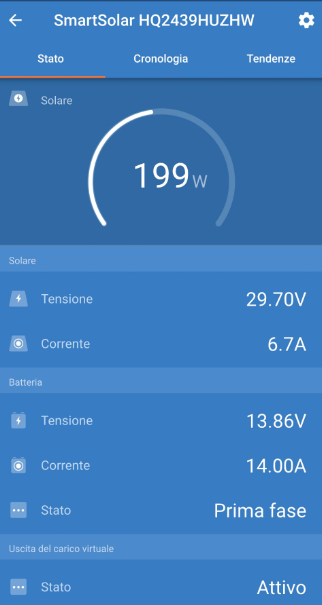
Good morning, (10:00 am), current panel output: 199W/29.70V/6.7A Battery voltage: 13.86V, current: 14A Bulk Voltage measured with a tester on the out of the MPPT output 14.02V, on the busbar, after the protections 13.65V and on the battery 13.47V direct contacts on battery poles, before the BMS
Thats both for absorption phase, doesnt matter as long as your in bulk phase.
Id rather look into those 0.5V loss you have between MPPT and battery. If the charger changes to absorption, then the battery is almost full. But if theres too big of a voltage loss, then the change to absorption happens too early
Yes increasing the absorption time will help, but as I said above in a well installed system absorption should only run for 15 mins. Your system is getting the MPPT to absorption voltage before the batteries are. Your problem is the 0.5V loss, you may need thicker cables and check your crimps, connections, fuses or breakers. Increasing absorption is whar we say in the UK is treating the symptoms, not curing the disease.
so that 0.5V difference makes my charging time decrease, did I understand correctly?
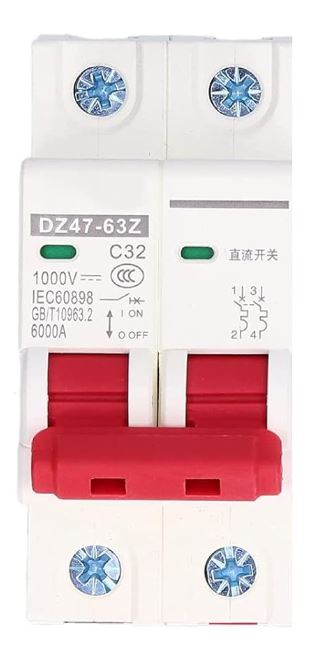
the loss occurs on this, it goes from 13.92v to 13.74v, before this there is a fuse and there is a minimal leak there too, I changed the fuse because it was oxidized, it worked for 2 months no more.
I want to clarify that I did not buy a quality product as it is a small test system, made in china…..
That 0.5V drop reduces the charging current and makes the controller swap to absorption and float beforethe battery is full.
You either need to reduce that to a much lower value so the voltage on the MPPT is close to the battery.
If you have a fuse and a breaker you could remove the breaker and just have a fuse. The normal fuses are bolted type midi fuses with a holder, you take the fuse out to turn it off.
If you have the SmartSolar version with Bluetooth then buy a Smart Battery Sense to measure the battery voltage and transmit that to the MPPT via VE Smart Network using Bluetooth, the MPPT then compensates for voltage drop. Again, not curing the underlying problem.