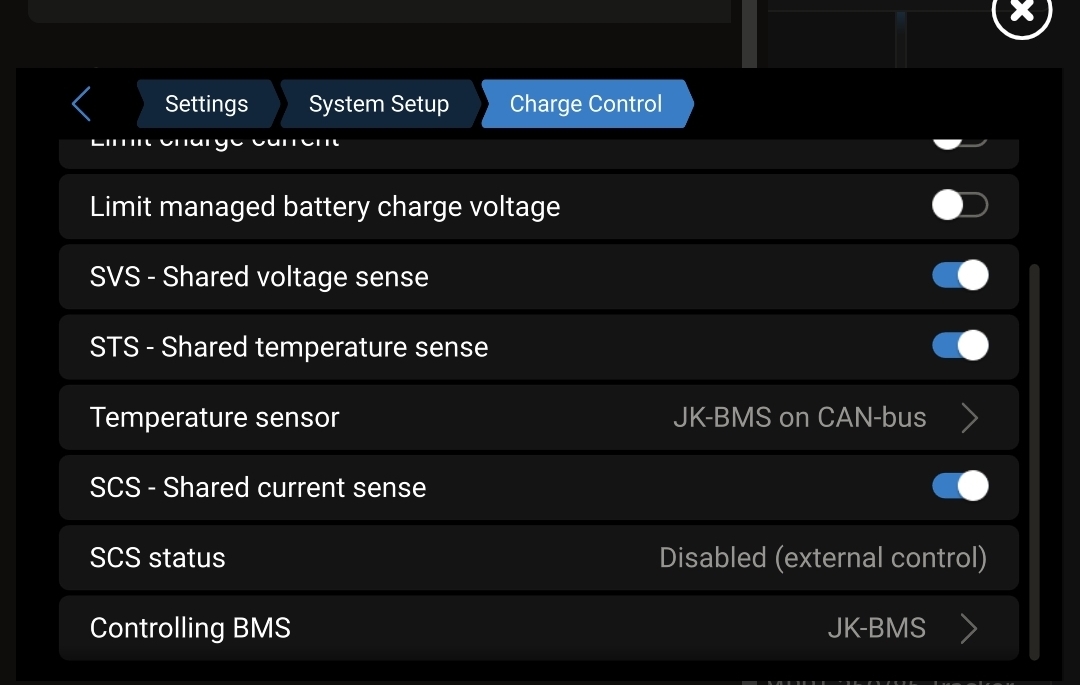
I built a DIY battery with Eve MB31 cells and Jk bms V19. Everything works correctly (connect VE can bms without packet loss, bms is set master on battery monitor and DVCC).
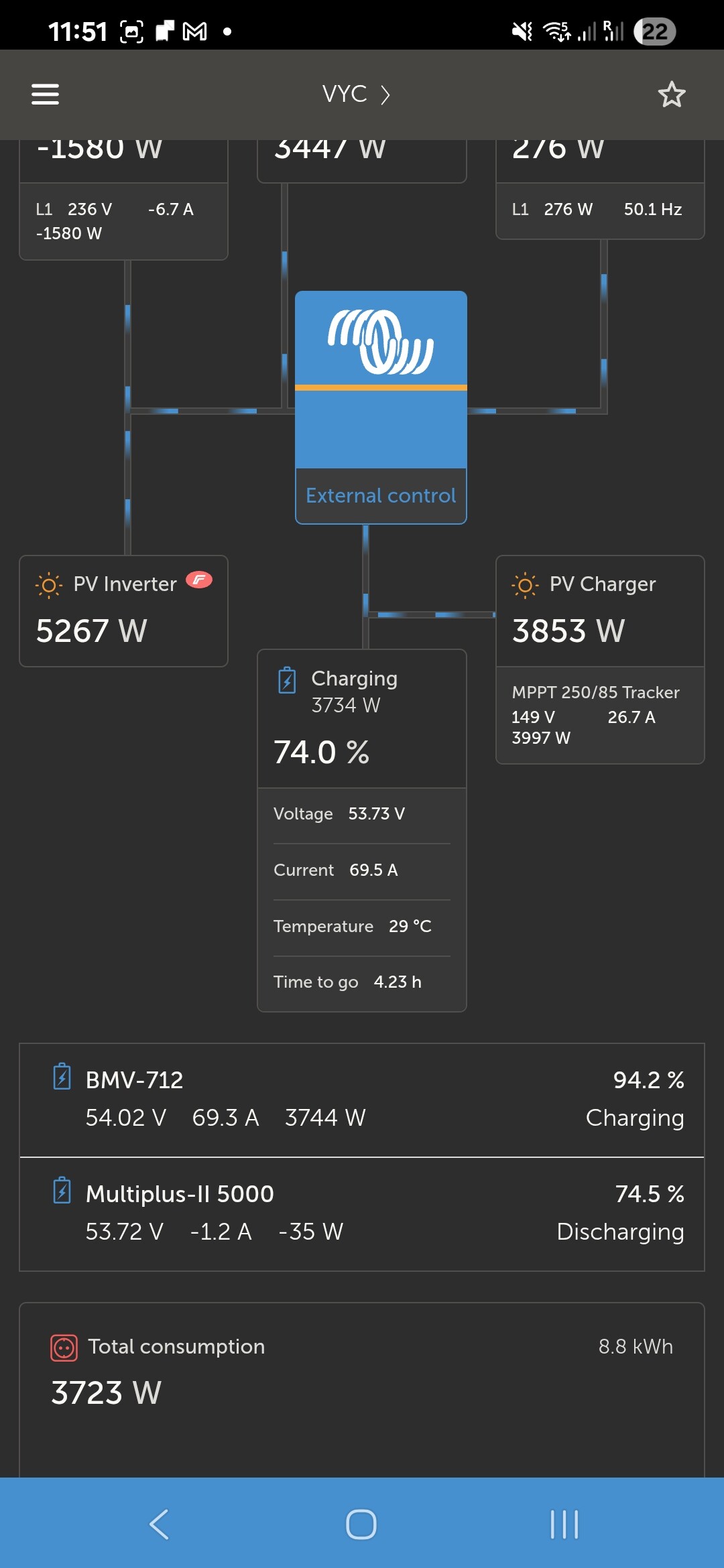
On bulk everything is fine (charging amps are corresponding with reading from BMV-712).
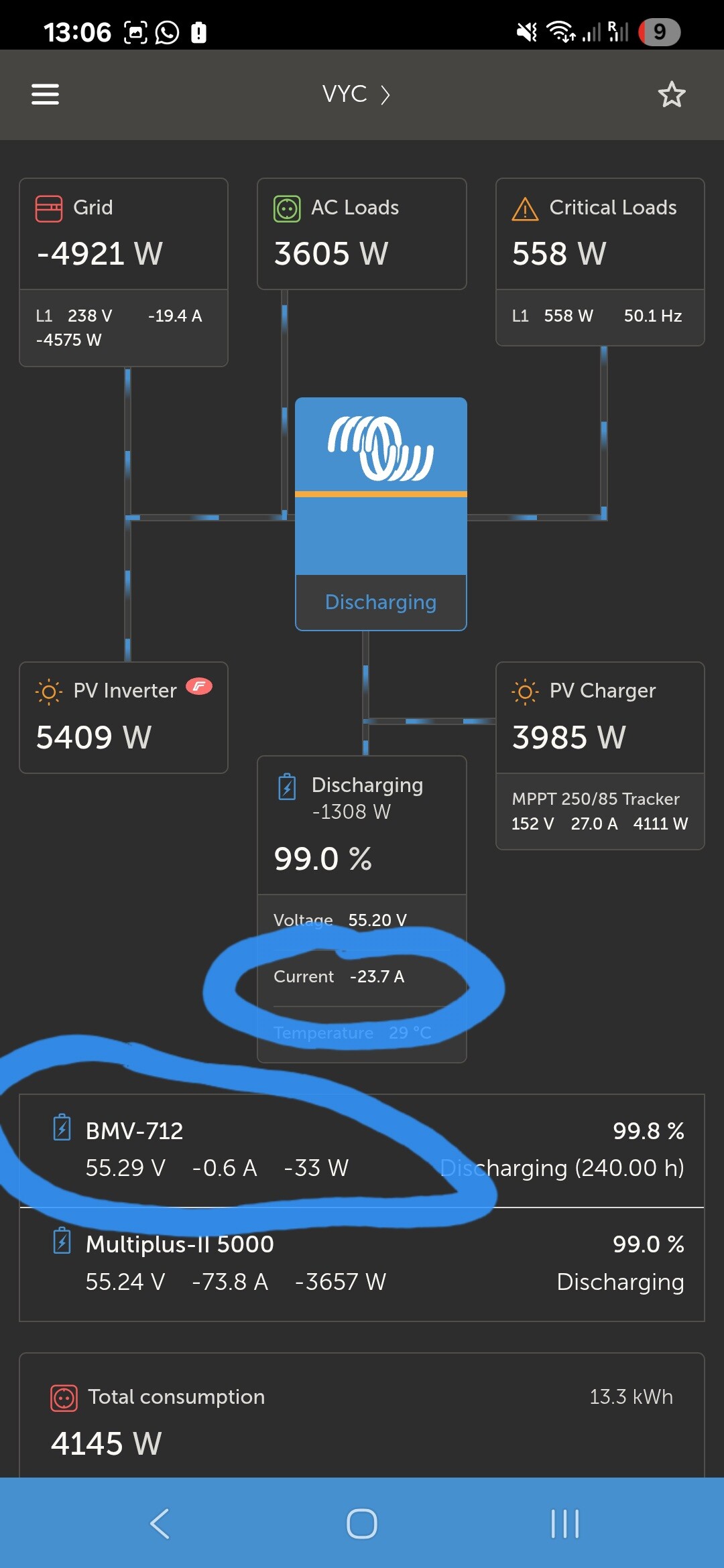
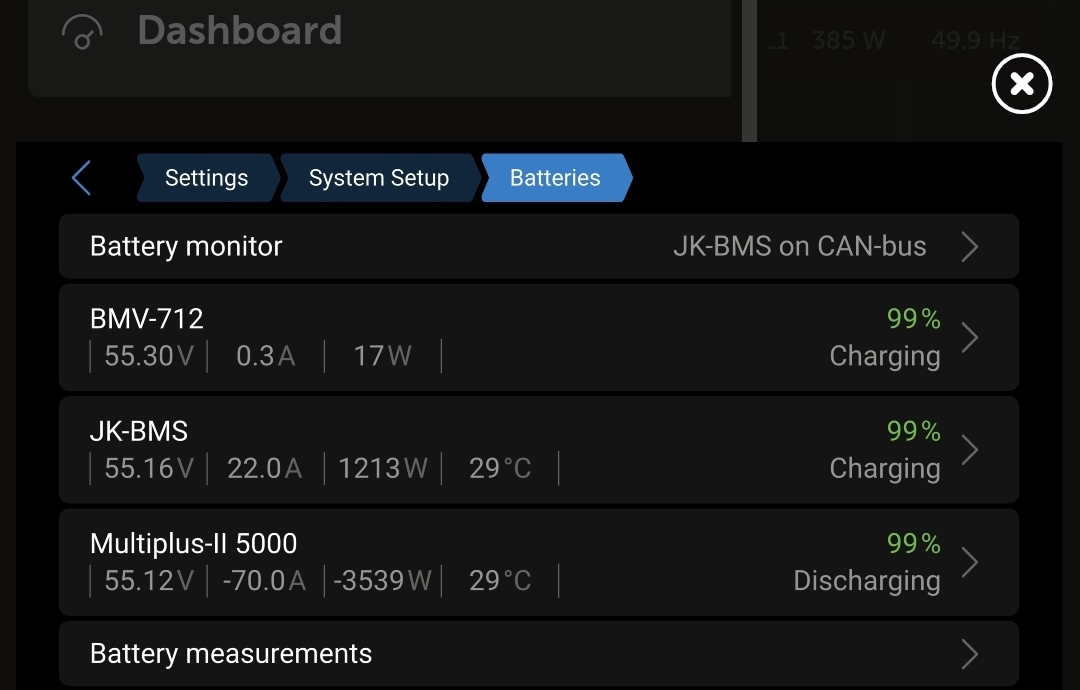
The problem is when it goes into absorbtion and decreases the charge to 20a. This is where it starts discharging and charging every few seconds. On the bms it shows that it charges or discharges with 20A, in reality through the shunt the current is almost 0.
Maybe someone has experienced this problem before and can help.
Don’t trust JK current measurement, use a proper shunt.
Reason of the incorrect current is the way JK measures the current.
They do measure peek current and not average DC current.
The current from and to Multiplus II isn’t DC there is a AC component on it (specially in on grid mode there is a lot of AC)
Specially at low currents this gives a measuring error, this is also the reason why SOC is incorrect.
There’s also a small voltage difference between the devices, have you measured the voltage or calibrated the JK BMS. Maybe just set the JK voltage to match the shunt? That might help with the charging/discharging.
The current is probably correct on the BMV and you can either try to calibrate the JK BMS again or ignore it. If you have a clamp meter you can verify.
The voltage difference is normal. It has a small voltage drop on the cables (between bms and Smart shunt). Anyway you can’t set perfectly because there is a small variation (lag) between what you see from vrm or Bluetooth on the phone connected to the bmv and what is real on the bms. With the voltmeter connected, the voltage has an error of 0.1V maximum.
Thanks for the advice but I don’t think this is the real problem.
There is a >0.1V difference visible in your screenshots. Even if there is a small voltage drop it might be better to try and match them. DVCC probably uses the voltage from the shunt. I’ve had 0.2V difference make the battery charge/discharge instead of idle.
Theoretically, DVCC should use the data from Jk. At least I believe so
I tried to disconnect the bmv for the same reason. The behavior at bms is the same. Charging /discharging on absorption… Even with master data from bmv, still same issue.
Now it is clear. Jk v19 bms has big communication problems with victron. If you don’t want any headache, stay away from this model. I tried my best without any real solution..
Thanks for answering. I’ll add one more video when it charge on bulk. Everything behaves normally. The problem arises in absorption.
Bms is not faulty. I’ve disconnected the mppt from the cerbo and I let it to charge the battery. Everything worked correctly on the bms. Bulk - float - absorption. Problems are with communication between bms and cerbo for sure. Many rules on ESS and DVCC. I believe there is the problem.
Video
Sorry but here I didn’t record from vrm. I’ll make another video tomorrow for bulk, tonight for discharging. All good for this conditions.
This is not communicated between the two, these are 2 separate measurements. Either one is wrong or there’s a fault in your system.
After that the JK BMS starts balancing the cells which can lead to the charging and discharging. This should only be a small current, not 20A. That’s why i think the JK shunt is wrong.
As others have recommended, you are better off using the shunt as the battery monitor due to the widely documented JK BMS current measurement problems and the accuracy of the shunt. I use the v15 BMS and have a similar problem with the measurement of small currents. Additionally, I cannot calibrate small currents (<10A), the software returns, ‘sending failure‘. This often results in wide SoC differences between the shunt and the JKBMS battery especially when 100% charge is not achieved over several days. I have tried several times to set the shunt to the JK BMS SoC, because there is no way (that I know of) to manually set the JK BMS SoC. All my experiments show that the shunt is a more accurate measure of SoC than the JK BMS.
In summary, I recommend using the BMS as a last line of defence to protect against battery (temperature, high current, voltage…) overruns and the shunt as a measure of the battery state of charge and disable BMS control.
I also tried this way. Only with the BMV-712 (jk bms out from can), but it has the same behavior. It does not behave correctly in absorption and in no way reaches the float. No idea what to do more then this. Probably I will order another bms (older version or another producer).
This is the behavior with or without bms connected on can. Charging and discharging on absorption (also check the balance in the cells when it does that) . BMV-712 read the correct data. Bms is in another world.