I have a site that uses a VM-3P75CT Energy Meter but the reading is not stable (see film). Is this normal behavior? I can imagine that this kind a measurement makes it hard for the multiplus to regulate the grid current.
The solar micro inverters are from enphase and measured with a victron ac current sensor.
Hi @JeroenSt, I believe what you are seeing is something Enphase calls “Burst mode”.
At low-light conditions, the micro-inverter charges an integrated capacitor, and once the capacitor is full, the micro-inverter injects a power pulse for a single or even halve a grid cycle.
Since the VM-3P75CT has a very high update rate, it will display these burst pulses which look like large power swings (because they are, but only for a brief moment).
I expect that the measurements stabilize not because your battery is full, but because the sun is up and the micro-inverters are operating in continuous mode instead of burst mode.
Here’s their patent if you are interested, and here a video in Dutch explaining the behavior you are seeing.
My MP2 (single unit on L1) + VM-3P75CT also does this. There is as much as 100W of fluctuation/oscillation. Feel free to remote debug/use as much data as you want if you need another test setup.
With more solar power the fluctuation is less, about 300 watts instead of 600 but still there. I don’t know if this is expected behavior? It is still a lot more than when the victron doesn’t try to keep the grid at 0 watts.
Is the CT clamp properly closed? The readings can get weird if the clamp is not fully closed. I had to wrap mine with a tie wrap, to prevent weird readings. It is pretty cramped in my distribution box
Yes I double checked it and it’s only giving fluctuations when the victron tries to keep the grid power at 0 watts. When the victron is idle the reading is more or less stable.
Same situation here with Enphase & VM meter: pulses in the evening and in the morning, or on a few gloomy days.
Maybe it would be possible to ‘go in between’ the measurements and create a ‘stable charge amperage’ from MPii to battery. Let the grid absorb the peaks without reacting to/so fast.
Hi Jeroen, what did you alter to test, and see it stabilising? I might have a go at it to, could rule out ‘individual layout’.
In my previous experience (this year q2/3) I saw more stable values based on the exposure of the individual panels. S-W panels when sun hits S facing panels, 2 a time will step of the pulsing and give a stable output. Same but other way round in the evening.
My thought was that eventually pulse/stable output (in W per panel, totalled for the 1 phase) gives a middle ground where you can’t measure or observe it as well, so MPii levels out instead of upping or lowering charge amps (pwm?) all the time.
Or is it not even changing on that level because it is just the measurements being very quick and VRM numbers follow without changing behavior in the MPii because they will take a median in a range of measurements.
@mpvader feel free to gather data, if wanted, KPN is already paid enough for a bit more usage.
Always interested in understanding better and learning something in the meantime.
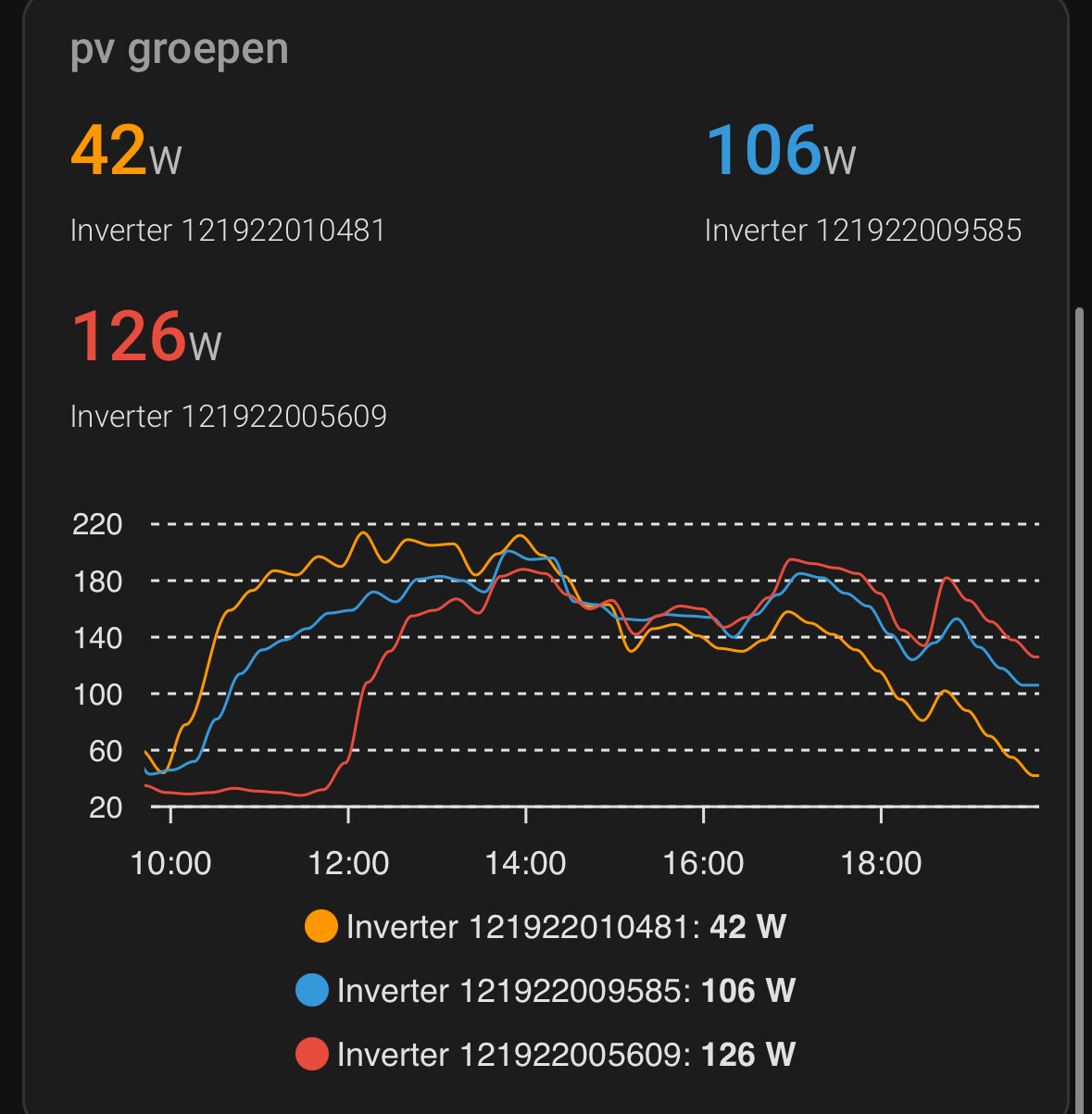
This is typical for rising or lowering sun. Three groups of panels due S, due W medium angle and W high angle. As per W output 1 micro inverter per group in graph: when a panel goes ‘low irradiance’-burst mode the VRM/VM will fluctuate. The high is when the group of panels bursts ‘all power towards the grid NOW’, lower level are the other panels on a stable level since irradiation is still ok for 100% time-output from dc to ac.
PS the battery is full now but the behaviour is not dependent on the battery. (Afaik)
PS2 my house-load certainly is not fluctuating this much, that’s part of the VRM-math-logic. Could be improved but no worry to me personally.
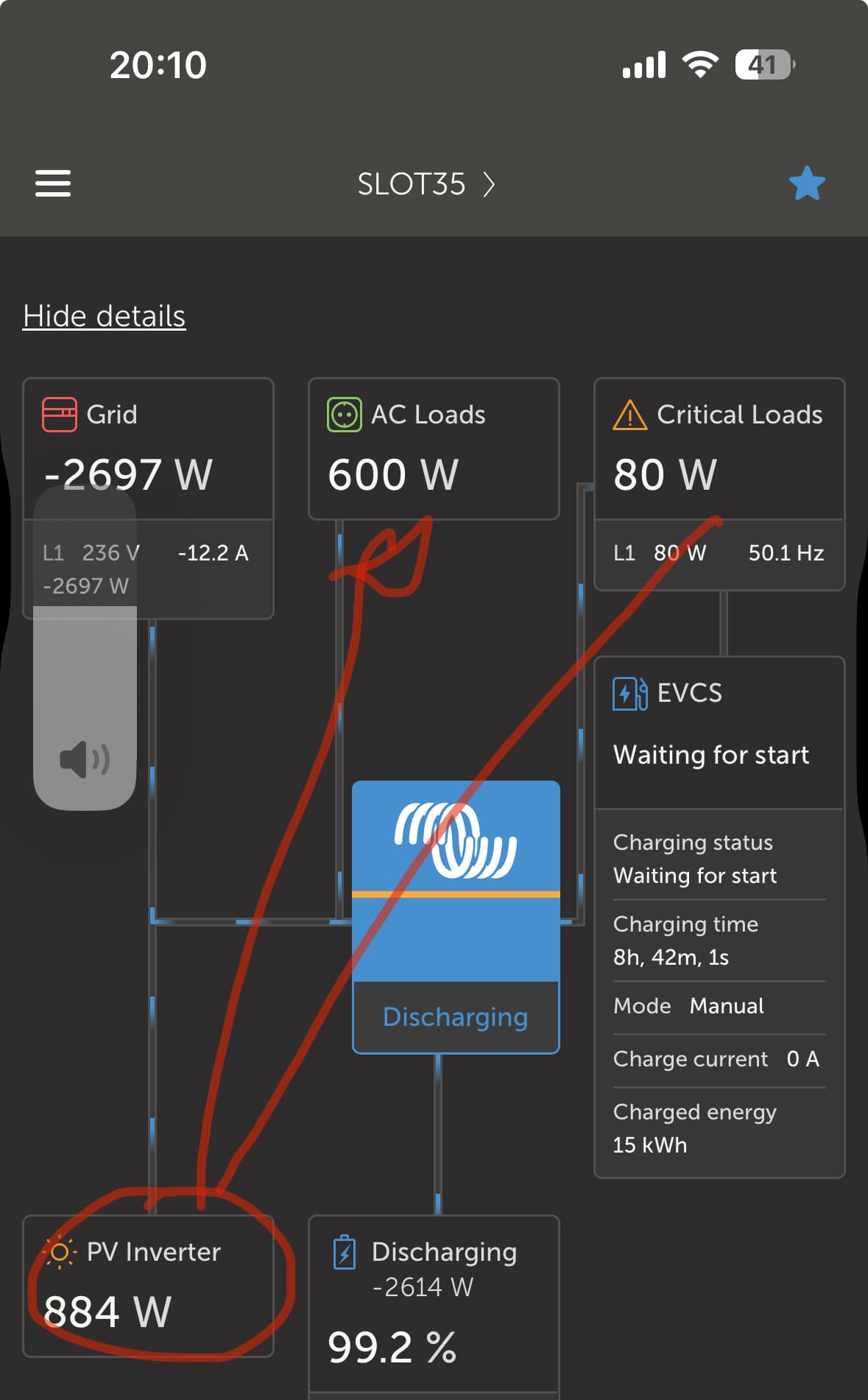
Math Logic part two: on burst of PV the VRM calculation will increase HouseAC and the same solo EVCS (solo on critical atm) in the same mode is displayed at 400% W usage.
PS3 in the morning, rising sun, VC perspective: same firmware, same placement but different ’role’ PV vs Grid. Those seem to have different algorithms for calculating ‘actual W’, PV looks like an average/median/… of a group of measurements while Grid looks like ‘every single measurement’ (?). If memory serves me well this was ‘fast updates’ for both roles (and V & A in details) on older firmware/VCversion (don’t know which since both were given the available updates)
Same problem here. I have 6 Enphase microinverters, and they also cause a highly fluctuating reading on the VM-3P75CT. As a result, ESS isn’t working properly. I have a second grid meter, a CT clamp meter, connected directly to the Multiplus II. If I choose the CT clamp instead of the VM-3P75CT, ESS is relatively stable. See images below; these are screenshots from Homewizard, measured at the main grid connection. My installation is single-phase. Images were taken at a relatively stable house load.
Hi all, a short update: we’re looking into adding a new configuration option into the VM-3P75CT to make it provide a moving average to the victron system.
Off by default, and then for system systems having an Enphase, or similar product, it can be switched on.