This brings us to the next topic. I operate a 100 kWh storage system consisting of 7 blocks of 16 LiFePO4 cells. I cannot charge or discharge my storage system with the power levels you mentioned. I don’t know which storage technology you use; it doesn’t work for me. At those charging power levels, my EVCC or BMS would immediately shut things down. Or the voltages would go extremely high when charging and extremely low when discharging. With my configuration, both would lead to dynamic shutdown. Which, strictly speaking, fits the symptoms you described. But the whole thing has less to do with the DESS than with the configuration of your Quatros. A side note… you should really think about what you’re doing to your batteries. I wouldn’t torture mine like that even once. Please give this some thought again. I’m not going to argue or discuss it; you have to decide for yourself.
Yes DESS settings they are accurate to how the quattros and batteries are programmed in veconfig and DVCC.
Jake
Now, the last thing that struck me, or rather, the thoughts that came to mind, is the relationship between your overall system, your consumption, and the battery size. You write that your AC-coupled PV serves 95% of your loads. That may be true, but certainly not all the time and certainly not during cloudy skies. Your consumption forecast will be very high. If the system detects a period where it expects low PV production, it will prepare to provide the entire load. This, of course, leads to extreme fluctuations. Perhaps the system is also holding back battery capacity for precisely this reason, so that it can still have power during even more expensive times. However, that’s speculation.
It’s 4x BYD lvl 15.6 totalling 60kw. They are rated for 1C. I limit it to 0.5C. this means if 0.5 c is exceeded then it makes up for surplus with the grid. My issue is once a consumption gets over the estimated consumption for the hour it doesn’t even bother during the batteries it just draws from the grid. Regardless of battery percentage.
Correction the BYD BMS limits the current output and 950 amps. Which at 54 volts totals 51 kW. I have said a discharge limit of 500 amps (27kw).
So that’s it from me for now. Good luck. Finally, something personal. I’m a farmer myself, a qualified agricultural engineer, but no longer active in agriculture. How’s the harvest going for you? My brother, who runs the family farm, is complaining a lot about the weather and is already worried about a drop in the quality of the wheat. Greetings from northern Germany
Entscheident sind nicht irgendwelche Parameter im DVCC oder BMS für die Parameter. Entscheidend ist was das System effektiv Läd oder Entlädt. Einfach ganz praktische Werte eintragen, was das System durchschnittlich lädt wenn es am Maximum ist
Sorry, that was German. I forgot the translator.
No worries yes that’s all I can think. It would be nice however if it were prioritise using battery over grid when in green mode.
By the way, I also have over three electric cars and, in the winter, the heat pump has highly fluctuating loads, and it works wonderfully for me. Here’s today’s screenshot. It’s great to see where the energy wasn’t enough last night, when the first car and then the second car went into the pits, and how the system handled the additional load from the battery. If I understood you correctly, that’s exactly what you want. So it works.
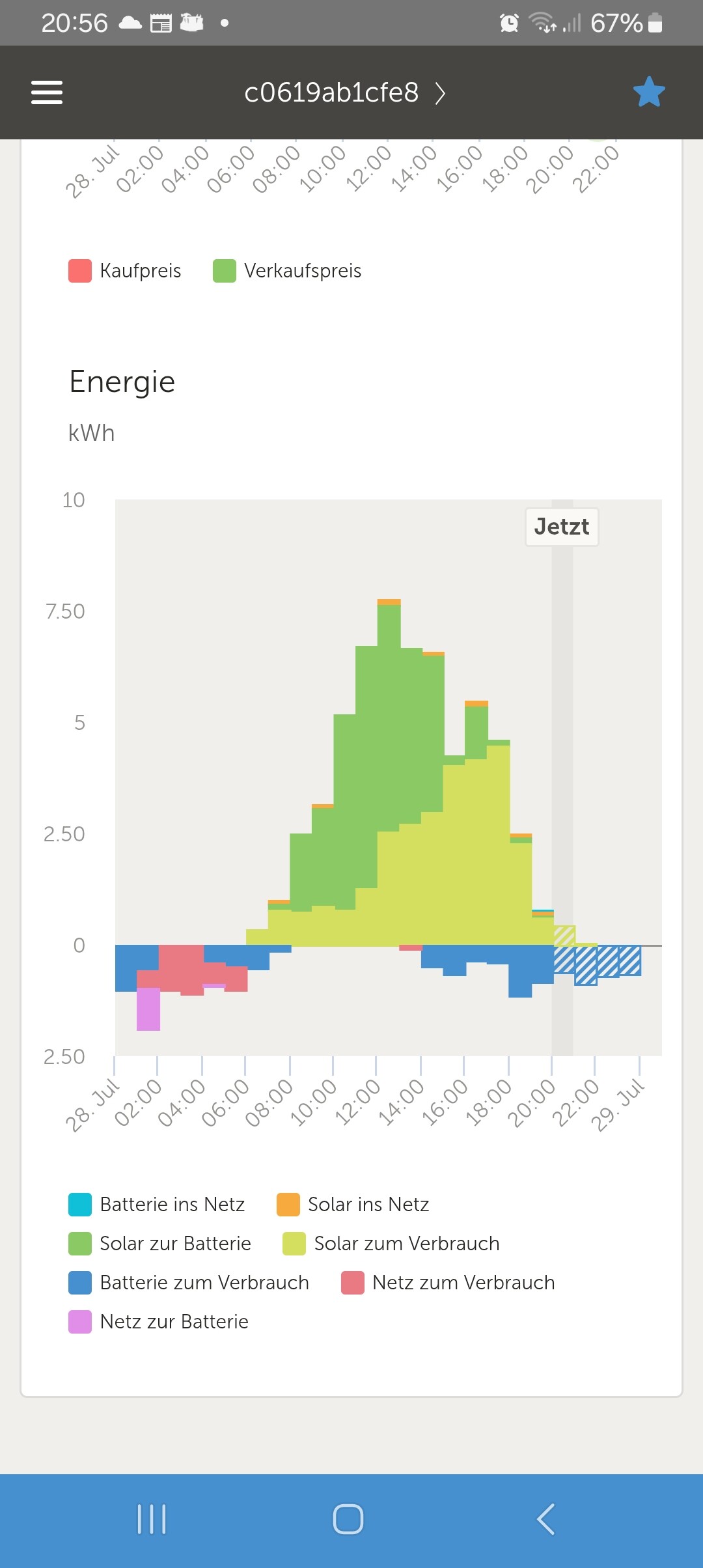
To add to that: This morning, the DESS bought or directly procured exactly the amount it needed until PV production began. As you requested. Today, it collected PV power, and when the high loads occurred—that is, the first BEV at 12:00 PM and the second BEV at 4:00 PM—it charged and prioritized the battery load to avoid drawing on the grid as much as possible. Also as you requested. I don’t want to depress you… but you see, it’s working. The question is why is your system reacting differently? It could actually just be due to some set parameter. Sometimes it’s detective work. But then it all falls apart.
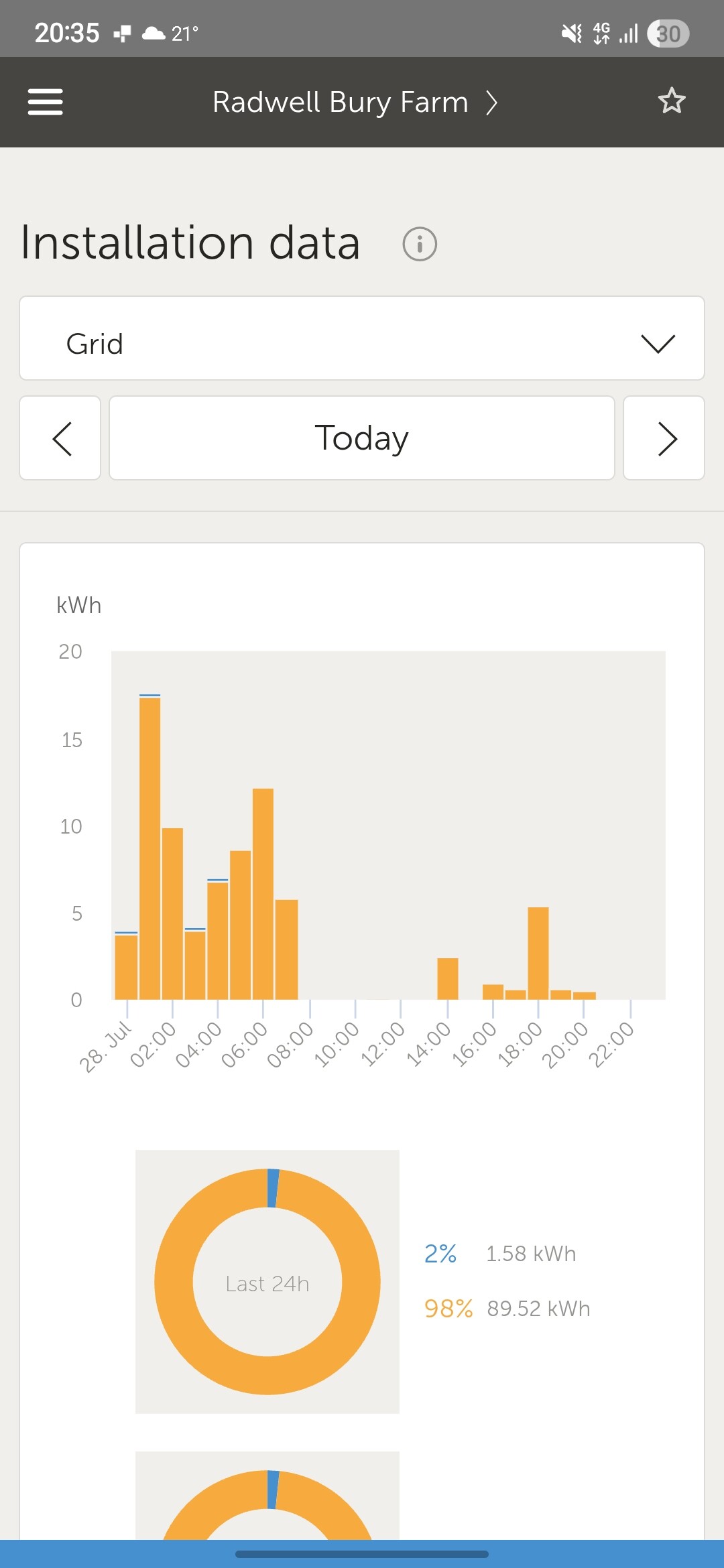
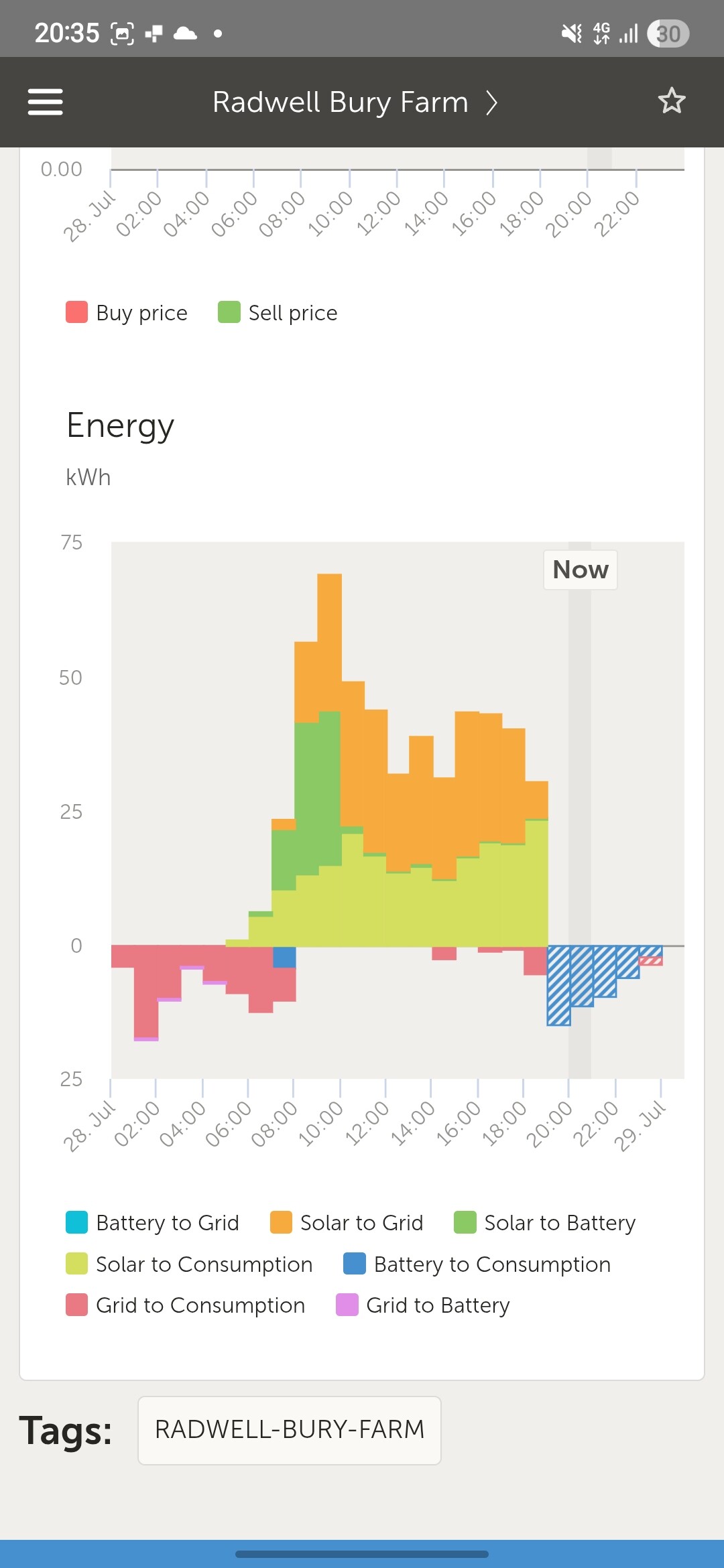
And what does the SoC say during that period? Again, the Dess principle works. I haven’t had any serious malfunctions since October 2024. At that time, the consumption forecast was revised again. But since then, the peak… That’s why I suspect it’s related to a parameter.

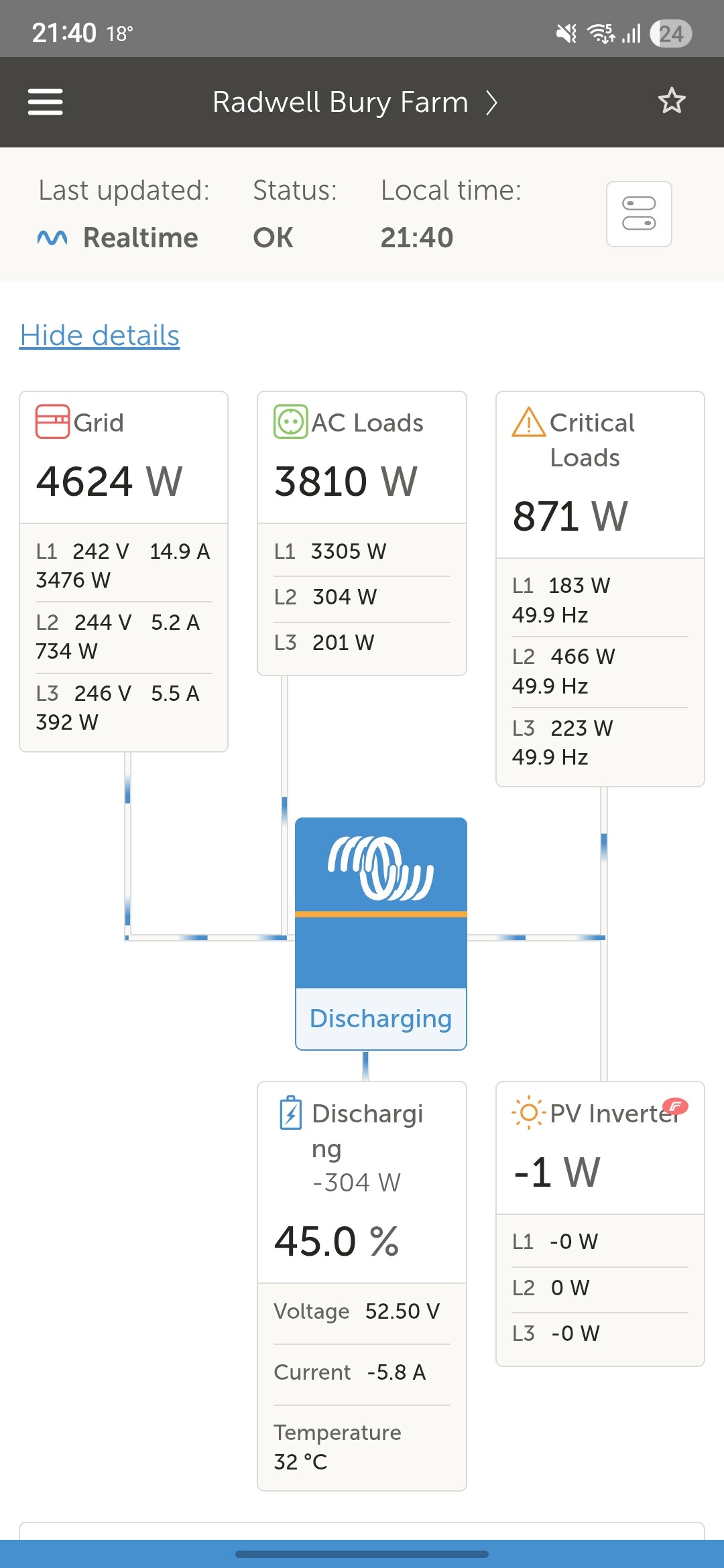
And when does it plan to use your remaining energy
Yes over the next few hours (till the night rate begins). Which I guess does make sense.
I’ve just had it in the past with 2 identical days one with DESS one without and the DESS day used more grid. (Even with the same solar, same usage etc etc).
Jake
I think I’ve worked out the issue - the 125 kW of solar has an export limit of 30kW, so it dials back if there’s low load and the battery is full to a minimum of 30 kW this then makes it struggle to forecast the solar through the day as it can fluctuate a lot regardless of how sunny it is. So if consumption exceeds a certain amount then it doesn’t think it will have enough solar later on in the day so it pulls from grid even though it actually will have plenty of solar as the solar can dial itself back up to well above 30 kW to power loads and charge batteries in the same brightness of the sun as before.
I basically just think it struggles to predict solar quantities - maybe it will improve as it learns the solar system better?
Hello,
i see two issues.
First, as you mentioned the export limit may be a big thing. As a workarround i’d recomend you to configure in your DESS a solar power capacity of only these 30kW, so at least the calculations may be a bit more realistic. Since more than that is only produced as long as the dryer and cold stores use it instantaneously, it should not affect the DESS that much.
Second is the storage capacity in relation to the consumption, this is more a problem in general with DESS (except you code your own in node red). 60kWh is a lot, but 300kWh per day is a lot more. I played arround with my own system for several weeks and finally came to the conclusion, that the victron DESS out of the box works fine only as long as the storage capacity nearly matches (or exceeds) the consumption. I saw similar issues as you described, unwanted battery loading in the morning and then feedin from solar and battery during the day - complete mess! Finally i coded my own DESS in Node Red and increased storage capacity to match consumption… now it works as needed.
Hope it helps!