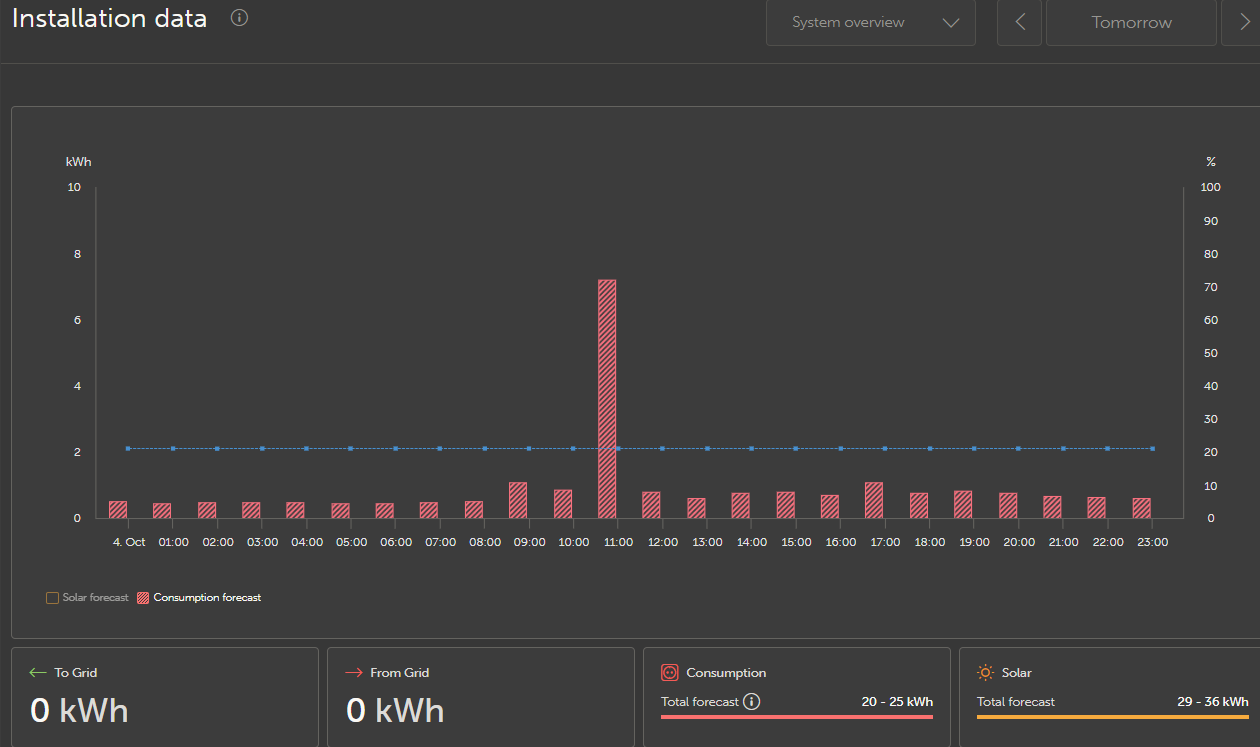
Tomorrow (4-10-2025) the energy price is the whole day around zero euro. (24H)
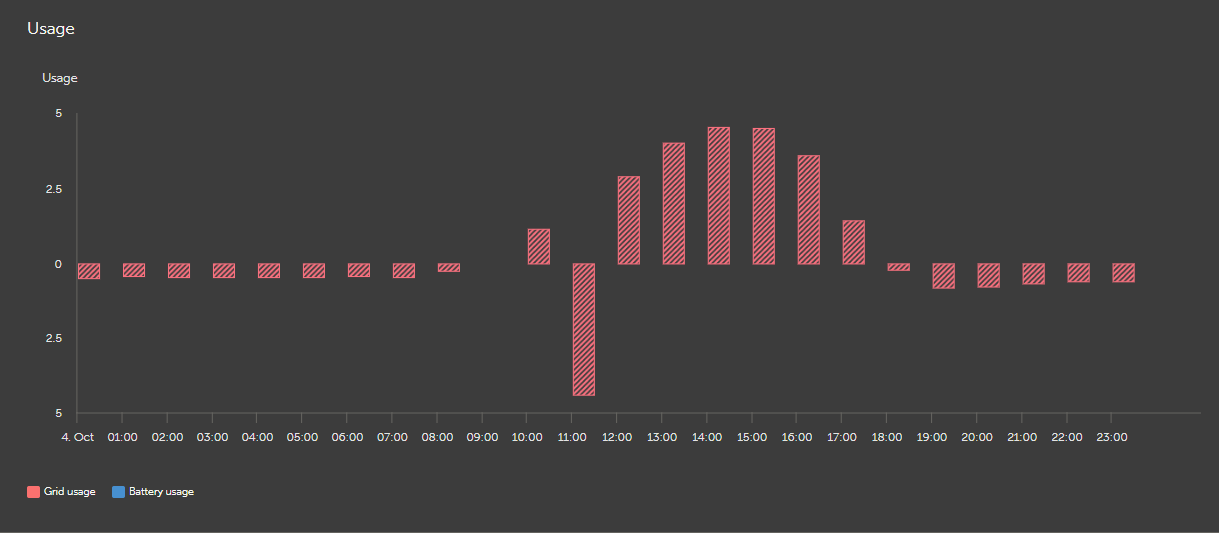
I should expect that the battery will be charged during the day because the energy is for free. But this is not the case. The SOC stays the whole day at 20%. See picture below
Even the energy of my solarpanels (forecast about 30kWh) will not be stored in the battery but send to the grid, but the price is zero.
Can some one from Victron have a look to this. The behaviour of the DESS algoritm is not logical to me.
In what scenario would that be profitable? That will only happen if the prices of Sunday are higher and what guarantee is there for that?
With battery cycle costs as a factor, the system sees no reason to charge.
The system could very well decide to start charging once tomorrows prices are in and they are above the current level + battery cycle costs.
I agree that this might feel counter intuitive, but if the prices on Sunday happen to be negative, we’d have people complaining that the battery was already filled on higher prices, thus loosing them money. The system doesn’t gamble on the price.
Enjoy the prices being so low. If you want the system to fill the battery today, the easiest way to do that is to set the min soc value high. And you could switch to green mode to make sure the solar gets stored in the battery / used for your own consumption.
Dirk-Jan Faber, thank you for the explanation. That is helpfull. I understand the first part of the explanation. The second part of the explanation how to store my own solarenergy on a day with zero prices is ofcourse possible as you describe, but that needs manual intervention.
I presume that you also pay a fee to your electricity provider, like Tibber et all, and possibly some kind of energy tax and VAT as well, no? That plus your battery cycle costs may add up and make it still too expensive to buy energy from the grid. We here wait for the sun to come out to charge our batteries. Might take a while, but this way to me is more fun.
Is this directed at me? I have stated my problem before:
I am pretty sure that a reasonably knowledgeable observer of the price graphs would agree that the chances are extremely low to non existent that the prices will stay at 0ct (before taxes) or only lower tomorrow, and the days thereafter.
May I ask why you focus on the validity of the observation/question instead of on the actual technical (systems control) subject at hand? In this specific situation I would think there need to be no discussion whether a full day of ~0ct prices is a good buying opportunity, and why. A key element to this has to do with the relatively large battery capacity in relation to the maximum power performance of the system. That makes waiting till next day prices roll in a missed buying opportunity.
And what if prices tomorrow are even lower, everyone would complain that the battery is already at 100%.
Just manual override DESS, predicting the future is only guessing an not a proper DESS strategy.
How many days a year have you seen prices drop below 0ct before taxes? There is a very distinct pattern that the 0ct price point is a pretty hard market limit, which is only logical as all the proffesionel energy providers a) do not pay all those fixed fee markups that consumers do and b) are pretty eager to turn off their power supply to prevent loosing money on supplying power. I bet you a beer you will not be able to find a single day where the before taxes price will stay more than 1ct below zero on average over the full day.
I take it you accepted the bet over a beer Now show me a day where the before taxes prices were more than 1ct below zero on average over the full day, that is the point here.
It is always possible to override settings even with simple NodeRed nodes.
[I let the battery discharge completely to 1.0% SOC this week, waited for the weekend’s favorable energy prices.
I have changed the settings Grid Feed-in to zero, SOC from 0% to minimal 50% and a CCL of 100A.
I charged the batteries overnight with 5 a 6kW power to fill the battery with approximately 75 kWh up to 13:00.
This leaves capacity for PV production. I will monitor the prices around 13:00 for Sunday to decide whether to adjust the SOC minimal to 100% for a full charge and balance the batteries.
I use trading with 150kWh storage and steer DESS like above , if my personal preferences are different than what DESS logically decides to do.
I do not complain with DESS shoving €6k this year.
It’s like driving a car, always adapt to the dynamics of the surroundings.
And there you already lose money.
The best you can do is charging during sunny days (or maybe you have more PV than than you can charge in your battery) because the prices are then low.
Basically storing the PV from your neighbor and selling it in the evening.
Slow charge until 13:00 then getting the Sunday prices and then decide further. Price this night and the whole day is perfect for charging and eventually let the storage balance a couple hours.
They use a prediction of solar based on the weather forecast.
Why not also use the predicted wind weather forecast in the strategy and predict a price drop before day ahead?
But first fix the SOC problems please, this cost real money.
I sometimes use ned.nl too within NodeRed but they are often way off with predictions.
There is nothing more unpredictable than the weather.
I think a system should have enough battery storage to meet the expectations.
But that is always answered with: Victron should handle it more efficiently.
But what about the ‘too big’ car in the drive way or the much to big Oled in the livingroom?
Who is to blame to not manage a smaller car efficiently enough? Some too small Ego perhaps?
Energy system intelligence is not just a snap with the fingers and everything is solved. It’s the total of every component that adds up to the difficulties or simplifications.
Pick the right dimensions, set the correct metrics. But everyone thinks he can beat the system and gets disappointed.
Start with the correct expectations and build up from there, but then comes in the component price and the oh and ah… So to save money picking smaller components and get disapointed afterwards. Just because only the investment was lowered and not also lowering the expectations.
Always trying to drive everything to the max with an 3000VA or 5000VA or even 8000VA and then complain about system efficiency… Blame the system architect but not Victron.
 Now show me a day where the before taxes prices were more than 1ct below zero on average over the full day, that is the point here.