Hello,
first some information.
The interface between the car and the wallbox is standardized by the IEC 61851-1 : 2019. The document is quite expensive if you want to get it, but I have an access through my company.
On the internet we can find for free the 2011 release which is sufficient to understand the subject.
When the weather is hot (from my experience when the battery temperature is above 26 °C) the behaviour of the Zoe with the wallbox is different from the one when the temperature is lower:
-
the Zoe request the charge during 6 to 7 s, request to stop it (ie request the box to open its relay) , launch fans and air conditioning system, and request again the charge (relay to close) around 10 s later. You can check that with a simple charger by monitoring the charge led.
-
with the Victron EVCS, the sequence stops (Zoe raise an error) just after the request to stop the charge. I get the sequence on an oscilloscope.
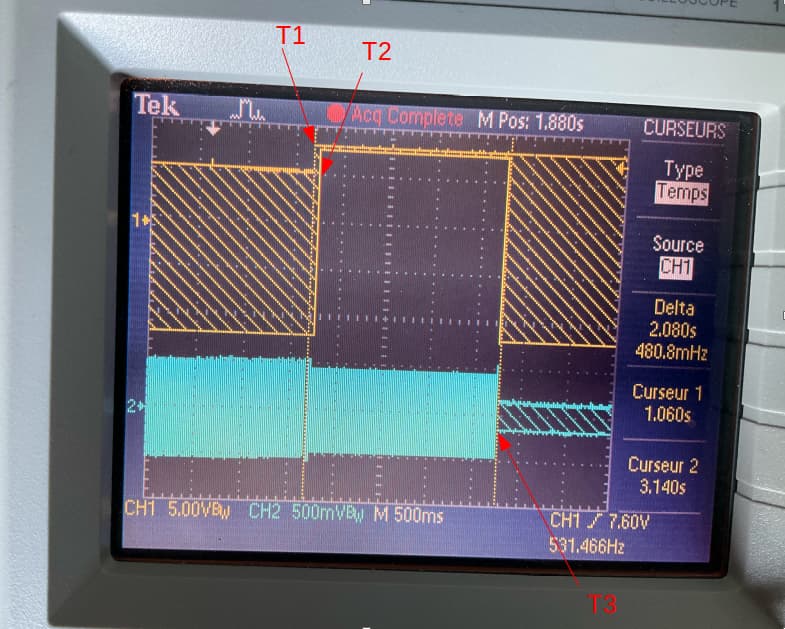
In yellow you have the Control Pilot signal, in blue the 220V availability after the relay (got with a wire rounded over the charge cable, not connected directly for safety).
If you don’t know the signalling level, you can read the standard or other doc on the internet.
On the picture you see only enveloppe of signals due to scanning speed ( 500 ms / division)
At T1 the Zoe request the wallbox to open the charge relay by raising the positive peak of the pwm signal from 6V to 9V
At T2 ( around 60 ms later) the wallbox stops the PWM signal : it is not request by standard and can be an issue for the Zoe which will need it few second later to request charging again
At T3 (around 2 s later), the wallbox open the relay, and the 220 v disappear. The problem is that it is a deviation from IEC 61851 standard, as the relay shall open at latest 100 ms after the Zoe has raised the PWM signal to 9V. If the Zoe check the compliance of that, it can also raise an error.
=> I think the problem we face is coming from one or both of this fact.
Benoit