This topic is very good! Based on what was discussed, presented and suggested here and in another topic here in the community about the same subject, I was able to satisfactorily solve the problem I was having! I am in a place that offers electricity with 4A circuit breakers, and the minimum input current limit value that my Multiplus accepts is 6A.
Below I make some comments about what was discussed here, after having read everything several times until I was able to assimilate and understand everything, and at the end I share the solution I implemented.
This is fundamental to the problem, and it is something that is not explained clearly and explicitly in the Multiplus manual. I don’t think it was explained here in this topic either, but it was said in the other topic on the same subject, that by disabling PowerAssist it becomes possible to configure lower input current limit values, and that the configured limit will be used in PowerControl.
Exactly.
Yes, the inverter’s capacity is not affected, but the inverter will not be turned on, the AC input will be supplying the load, and with PowerAssist turned off, when the AC load current exceeds the input current limit, the AC input current will also exceed the limit!
No! With PowerAssist turned off, the Multiplus will only be able to keep the current at the AC input below the input current limit while the AC load is below this limit. It does this by controlling the battery charging current. As the AC load increases, it will reduce the battery charging current (PowerControl function) to keep the AC input current below the limit, until the battery charging current is zero. If the AC load current continues to increase, it would keep the AC input current below the limit by turning on PowerAssist, that is, using the inverter to supply the current that exceeds the input current limit. But since Power Assist is turned off, it cannot limit the current drawn at the AC input, and it will follow the load current, until it trips the circuit breaker of the circuit to which the AC input is connected!
Perfect
I was trying to do exactly the same thing! Using an inverter that is actually half the size of yours, 600VA, to charge the battery in the trailer using the car’s alternator. But I had two problems when I tried, first I couldn’t set an input current limit lower than 6A (I needed to be able to set it to less than 3A), and then the 600VA inverter would go into overload protection mode. The second problem I believe was caused by the BoostFactor, which can make the Multiplus inject current for a few moments into the AC input, which I believe my 600VA inverter couldn’t tolerate and that’s why it failed. 
Disabling PowerAssist when you are traveling can solve the problem, by allowing you to set a lower current limit value for the AC input, but remember that the limit you will set is not the 1200VA of your inverter, the limit must be what your car’s alternator can supply, which can be less than 1200VA! And then you also need to consider that without PowerAssist turned on, the load limit you set to pull from your alternator is also the AC load limit that you will be able to have connected to the trailer, because there will be no control over the current limit drawn from the alternator if your AC load on the trailer increases. Maybe this is not a problem for you, if you do not need any high AC load connected during the trip (but you will always need to be very careful not to forget something connected). But for me it would be a problem, because I need to leave the trailer’s air conditioning on during trips. And if your AC load on the trailer is never greater than the capacity of the AC input circuit you are connected to when stopped, you do not even need it To reactivate PowerAssist, you can leave it turned off. However, to solve the problem in a much more robust way, without having to worry about the possibility that your AC load may eventually be greater than the capacity of your alternator or the capacity of the AC circuit to which you are connected when stopped, you can configure the solution proposed by Stefano below, using Node-Red, or the simplification of this proposal, using the Multiplus assistants (as I will present in detail below), so that the AC input is disconnected when your AC load exceeds a certain power limit (which may be the capacity limit of your alternator). If this situation is infrequent and does not last long, you can leave it configured like this always, without having to change the settings that need to be made by VE Configure, and the result will be satisfactory. You can still easily change the current limit of the AC input to be able to use all the available power to charge the batteries, charging that will occur whenever your AC load is not above the limit configured in Node-Red or in the Multiplus Assistants to disconnect the AC input. I think that with these solution possibilities, especially the solution using Multiplus assistants makes it very easy to find a good solution and it becomes too complicated and unnecessary to have a second charger in the trailer just to be used to charge the battery using the car’s alternator.
Great idea, Stefano! Using your idea, I was able to implement a solution to the problem using Multiplus Assistants! I’ve already set it up and am using it, and it’s working very well!
In my case I used the Multiplus Assistants (what is HA?). In the Multiplus assistant what is monitored is not exactly the AC load current, but the power in Watts being consumed by the AC load, but it serves the same purpose.
In this case, through the Multiplus Assistant, it is placed in inverter-only mode, ignoring the AC input.
You don’t need to keep enabling and disabling Power Assist. You can always leave it disabled, because you will never use it. When the AC load is above the limit (6A, in your case), if you are going to put it in inverter-only mode, Power Assist will not be activated! Power Assist works by adding power produced by the inverter to the power available at the AC input. If you are going to be in inverter-only mode, all the power for the load will be produced by the inverter; there is no Power Assist in this situation! Likewise, you do not need to keep changing the AC input current limit! The AC input current limit is a parameter that will not be used when the AC input is not being used, and it will not be used when you are in inverter-only mode! In this mode, 0 amps of the AC input will be used; there is no need to have a limit configured! So you can always leave the AC input limit at the value you need, 6A in your case. Since it is not necessary to turn Power Assist on and off, nor to change the AC input current limit, and since it is possible to force Multiplus into inverter-only mode, ignoring the AC input, it is possible to implement this solution using Multiplus Assistants, there is no need to use Node-Red!
The problem of increased AC load is not for the Multiplus. You do not need to have set an AC input current limit for the Multiplus to support the increased AC load. The problem of increased AC load is for the circuit to which you are connected at the AC input, the AC input current limit is there to protect this circuit from overload, not to protect the Multiplus! And you will be protecting this AC input circuit by putting the Multiplus in inverter-only mode (ignoring the AC input), not by increasing the AC input current limit! In the Multiplus Assistant I set how long after the AC load exceeds the limit I want it to take for the AC input to be disconnected (ignored). I set it to 0 seconds. I have been testing it since yesterday and it is working very well, I can connect a very high load (like the Air Fryer) and the AC input is disconnected without the circuit breaker of the circuit to which I am connected at the AC input tripping. Below are the Assistants I created to implement this solution (I set the limit to 880W because in my case the circuit breaker for the AC input I am connected to is 4A, and the voltage is 220V).
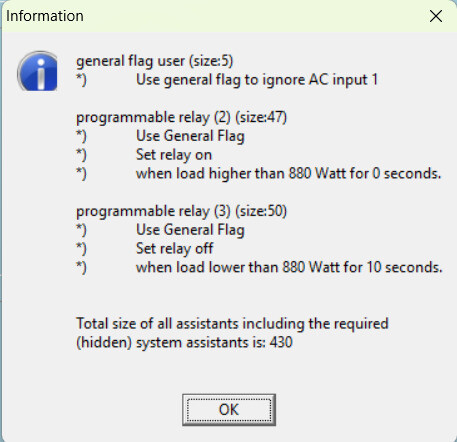
With these assistants and with PowerAssist disabled, I can set a current limit on the AC input as small as necessary (without being limited by the minimum value allowed by Multiplus when Power Assist is enabled), taking advantage of the maximum possible power to charge the battery while the AC load is below the established limit, and disconnecting from the AC input when it is above the established limit, so as not to trip the circuit breaker in the AC input circuit, or not overload the car’s alternator, for example.
And if it is not very frequent or long lasting that the AC load is above the configured limit, I can always leave it like this, the only downside will be in those sporadic and short moments when the AC load is above the configured power limit, moments in which the Multiplus will be disconnected from the AC input. It will still be possible and easy to modify the AC input current limit to be able to take advantage of the maximum power available for charging the battery, power that will be used during the entire time that the AC load is below the power limit configured in the Assistants.
Everything we’ve formulated here in this exchange of ideas could be included in some Victron document, because I think this possible solution is very useful for many people! I believe that this limitation of the capacity of the outlets available in campsites is very common for users of electrical systems in RVs. In the part of the Multiplus manual where it says the minimum current limit values of the AC input, they could explain better that these limits only exist when PowerAssist is enabled, but that it is possible to configure lower values to be used by Power Control if Power Assist is disabled! And then they could include a link to a short document that explains this way of getting around this Power Assist limitation using this programming in the Assistants!
I hope that in the meantime, all of my comments here will help anyone who is having this problem and can find this conversation!