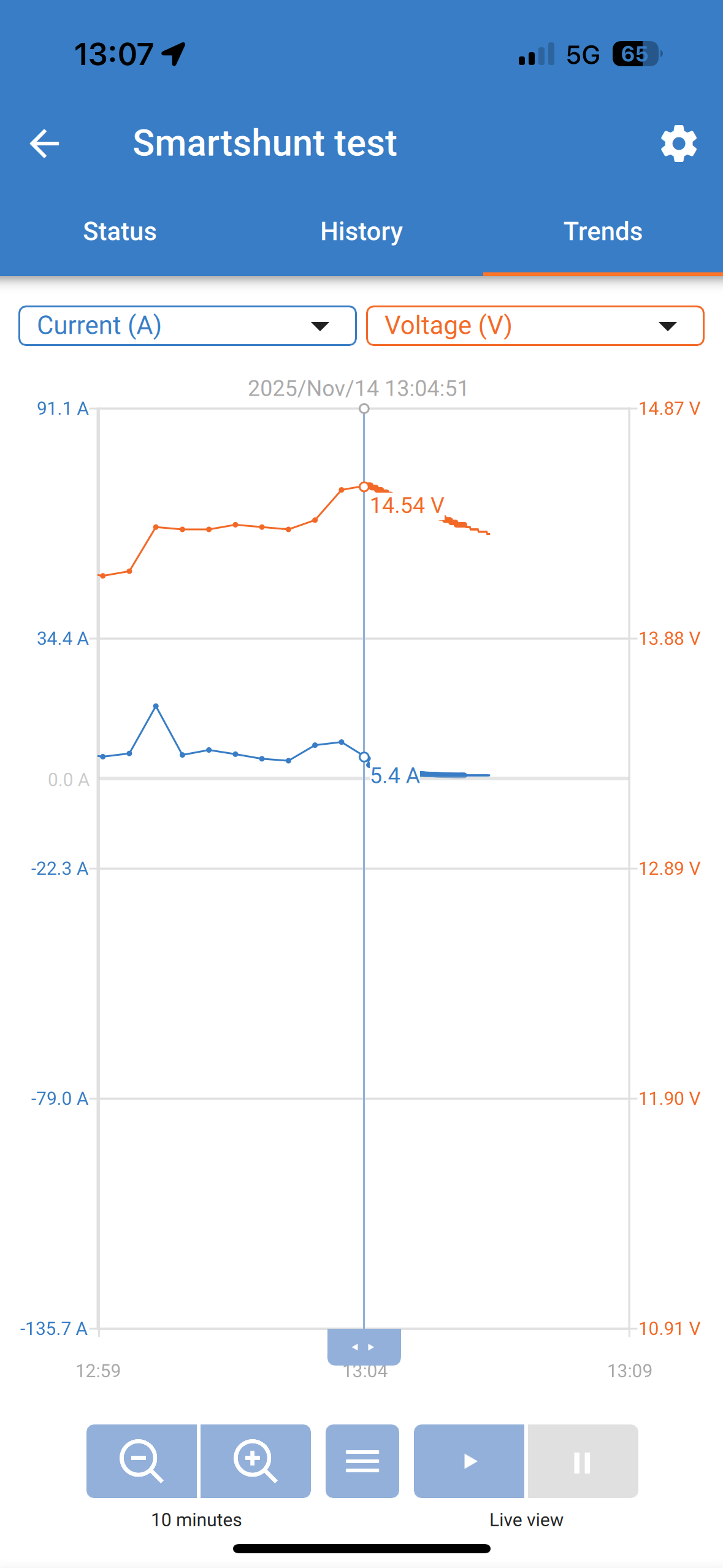
I’ve got the new MP II and programmed the settings according to Li-ion batteries. So far so good. There are a few unexpected things however and I hope there is a reasonable explanation for it: When charging to the absorption voltage of, e.g. 13.8V (but this can be 14.2 too), after reaching the absorption voltage the charger goes into float after the absorption duration. So far so good. But, it also decharges with around 0.3A the batteries until it reaches this float voltage. It does this untill the the float voltage has been reached. Why is that? See pic below.
Furthermore, I notice that on the end of the absorption charge, it raises the voltage for a while to pump some more Ah in as it looks like. It does this at every absorption voltage setting. As well as 13.8 as well as 14.4V. So, it raises the voltage to almost 14.6 for a while to pump in a little more Ah and then goes to float. Cells will be above the 3.6 then for a while, which I would never do to a LifePO4 cell myself. See pic below. Is an Victron engineer reading this forum and does he or she has an explanation for this?
This is normal: Once Absorption phase ends, the Charger voltage drops to the float voltage. However, the battery is still at the higher Absorption voltage, so it will discharge until the battery voltage drops to the float voltage. It may be worth increasing the float voltage. Check against the manufacturer’s data.
Note that the multiplus voltage readings may not be too accurate, this should be checked with a good multimeter (not a cheap one). If the battery has an internal BMS, then a voltage spike of the multi may indicate that the battery is disconnecting briefly due to high cell voltage. Best to reduce your Abs charge voltage by 0.5V, see if this behavior disappears.
Thx Mike. You say this is normal, however, I don’t think it SHOULD be normal. Of course the charger drops it’s voltage to the lower float voltage. That should not mean the battery should be discharged via the charger imho. This way it’s not possible to charge your batteries to full, as soon they are full they get discharged. Not ideal for a situation on a boat e.g. So I don’t get it why (if it is indeed a software feature of the Multiplus) this should happen. (setting the float voltage to the same voltage as the absorption voltage is not an option; you don’t want to leave your lifepo4 cells at 100% for a longer time)
This is primarily a hangover from lead batteries, which as soon as you started to charge them increased their voltage by about 1.1V. So when fully charged, the charger could then drop the voltage by about 0.9V and still be charging the battery.
With lithium this effect is not so great, and most manufacturers give a long term float voltage as a specification. This would apply if the cell were left on float charge for months, and is about 3.4V per cell. So to get a full charge and keep it on a lithium battery, IF you are only going to be on the charger for a few hours, then the float voltage can be increased to ~100mv (25mV per cell) below the bulk charge voltage of 3.55V per cell. Then the battery will stay at full charge. This is not done for long term float charge as the internal corrosion rate is correspondingly higher. The final choice of float voltage depends on your application. In my solar system, the ‘charged’ (Abs) voltage does not get dropped after a few hours, but remains at 3.55v to maintain balancing.after about 2 hours on full charge the sun goes down anyway, and we discharge overnight.
Thx Mike, for thinking with me. But, it might be as scaring as you are saying. This could be a hangover from lead acid batteries. The more I know the MPII, the more I’m convinced this one is not designed for mobile/maritime situations. It’s certainly not the best for this situation. It’s ridiculous that after charging the battery to full it get’s discharged by…..THE CHARGER!
(I’ve studied Electronics and have gone deep into the LifePO4 the last year. There’s enough prove that charging with 3.45/cell / 13.8 also charges the battery nearly 100% full, if given enough absorption time. With that there’s no stress at all for the cell. So, the Victron 14.2 or 14.4 might be a bit outdated. Floating would be best a bit lower than de absorption voltage, if not necessary you don’t want the cells be at 100% for a longer time. So, in case of using the MPII on a boat, floating would be anywhere around 133.2-13.5 and not at 13.8, where the absorption is. So, in maritime situations you want to charge the batteries only to 100% (13.8) when going for a longer trip. If you have to be aware that the charger discharges the battery after finishing the absorption, then this sounds more like a bug than a good feature.The MPII doesn’t make me happy at all, the recurring absorbing which cannot be switched off, the lack of an tail current to tweak to your battery capacity, and now this, this is by far a good charger for maritime use, like the simple Smart chargers are!)
It’s not the charger discharging the battery, but any DC loads.
The MP2 is fine for use in a marine environment, it’s just a question of how it is set up. Lithium are best charged to 90% on a regular basis, and not discharged below 10% (giving 80% dod).
It’s best if there is an active BMS measuring the cell voltage and controlling the charge current to optimise balancing. If you don’t have this, then it’s wise to back off the Abs voltage and extend the abs time. As you mention Li batts will charge to near 100% at 3.45V per cell - the amount of extra charge in going to 3.65 is really small. This is the excess charge that is discharged when switching from Abs to float. Recurring Abs period can be extended, but is not generally an issue.
Like said; it’s the charger who’s discharging. There aren’t any DC loads. It’s a test setup. So, that being said; you still think it’s normal? All things you recommend are in place, of course. All is managed by BMS, but that’s not the problem here. It’s a very simple story; the MPII charges to the set absorption voltage, absorbs for the time it’s programmed and then goes to float and discharges the battery with around 0,3A. Feature or bug?
Sure, but that’s not happening / the case here. It seems that I’m repeating myself Is it that you are doubting my measurement? Or is it simply you can’t believe the MPII is doing this?
The multi will take a standing current from the battery in idle mode, this may depend on whether the device is in invert mode with AC in, OR charger only mode - if it has this.
Either way, this is negligible, and normal behavior. No reason not to use it.
It happens in charge mode. If this would happen in inverter mode, this would be ‘normal’. However, a charger normally does not discharge a battery. Or, let me rephrase that; I don’t know of any charger discharging batteries. The far more cheap Victron Blue Smart chargers e.g. are NOT doing this. I stand my case that this is weird behavior and unexpected. It surprises me that it looks like I’m the only one complaining about this……


 Is it that you are doubting my measurement? Or is it simply you can’t believe the MPII is doing this?