I have a battery pack with charge/discharge current about 190 A (Pylontech). I also have 2 MPPT 150/100 and 150/85. So max charging current is 185 A from those two MMPTs.
I would like to add another MPPT (most likely 150/60), however, since I have Grid feed in enabled, it is possible that all MPPTs would charge the batteries with much higher current (total max current from MPPTs would be 245 A) because the DVCC is ignored. Is there any possibility of how to limit the charging current from MPPTs via ModBus? I have Loxone system and would liek to limit the current in some specific scenarios.
Hello, no, Loxone is not installed on any PC. It’s kind of PLC. I already have Victron connected via ModBus TCP/IP. However, I didn’t find any address to modify the charging limit.
If you do have access to the VE-direct i.e. it is not used by a cerbo or other gx device, then controlling the Charge current is easy, but be carwefull to use the right register - only one register is intended for dynamic control of current thwe other will wear out the eeprom.
ESS max charge current I think is an AC measurement, DVCC is definitely the DC measurement.
IF Grid feed in is enabled, the CVL (Charge voltage limit) of the MPPT’s is increased by 0.4V, so the inverter will try to reduce that amount of voltage by exporting power to the grid. If P(mppt) is >> P(inverter) then the dc voltage will rise above the CVL. This may cause high current / Voltage situation on the battery.
You’re better off adding a grid-tied PV inverter to the system. The MPPT should be sized so it can fully charge the battery within a day using DC charging alone.
By adding a grid-tied PV inverter, any excess solar is exported directly to the grid. This avoids unnecessary DC-to-AC conversion losses through the main inverter. If the battery needs more charge, DVCC will automatically use the excess power from the grid-tied PV along with the internal charger, to top it up.
This setup maximises efficiency and ensures no solar generation is wasted.
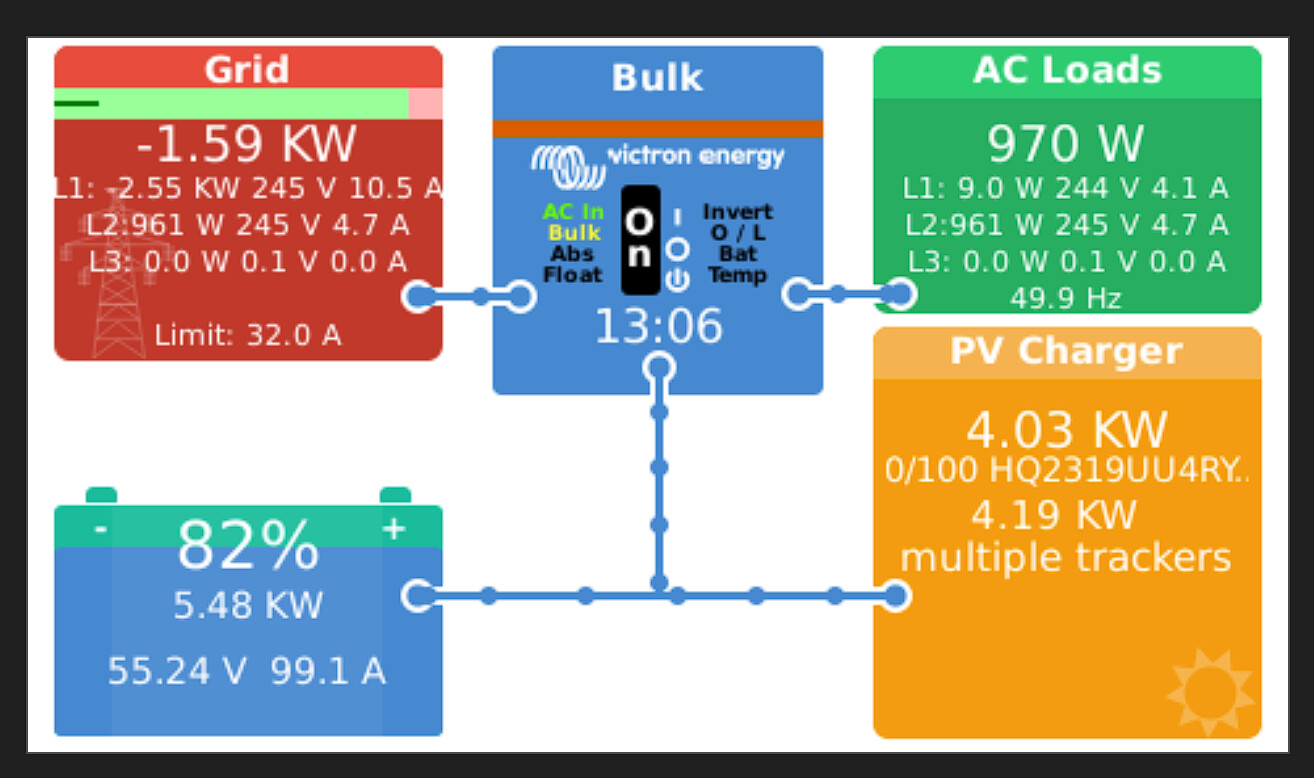
This is what it looks like. 4kW from the MPPT and 1.5kW from the internal charger. DVCC set to 100A.
I have 3 Multiplus II 3000 it it is what you mean. The problem is that if the Grid feed-in is enabled, the DVCC is ignored. So my batteries have around 190 A charge/discharge current and have 2 MPPTs with 185 A current. I’ve been told on the training few years ago that if I add another MPPT and the sum of the produced current will be higher than the charging current of the batteries, it will damage the batteries because the DVCC is ignored when grid feed-in is enabled.
So that means when I want to add more mppts I have to also add another batteriees to higher the charging current.
If you add a grid-tied PV inverter, the Multiplus will automatically use any excess solar generation (that would otherwise be exported) to charge the battery.
DVCC doesn’t directly control the MPPT charge current, but if the DVCC charge limit is set higher than what the MPPTs are providing, the Multiplus will supplement charging using its internal charger.
You should size the MPPT chargers to handle your normal battery charging requirements. If you need additional solar capacity, simply add grid-tied PV inverters but don’t AC couple them to the Multiplus output. Instead, connect them directly to the grid.
In my setup, I have two 5,000 W PV inverters, with one connected to the Multiplus AC input. The Multiplus automatically uses any excess solar from that inverter to power household loads or charge the battery, depending on system demand.
The other option you have is to set the grid set point to negative. I do this in the morning to dump some solar when the battery is over a certain %. Or, something I have thought about but not tried. Disable grid feed in for DC when the battery is charging. This will allow DVCC to work. When you have finished absorption, set it to export excess. It will be very inefficient to do it that way. It will be very easy to do in Node-RED. I have a flow that disables exports when I lose the energy meter for the grid. It works well.