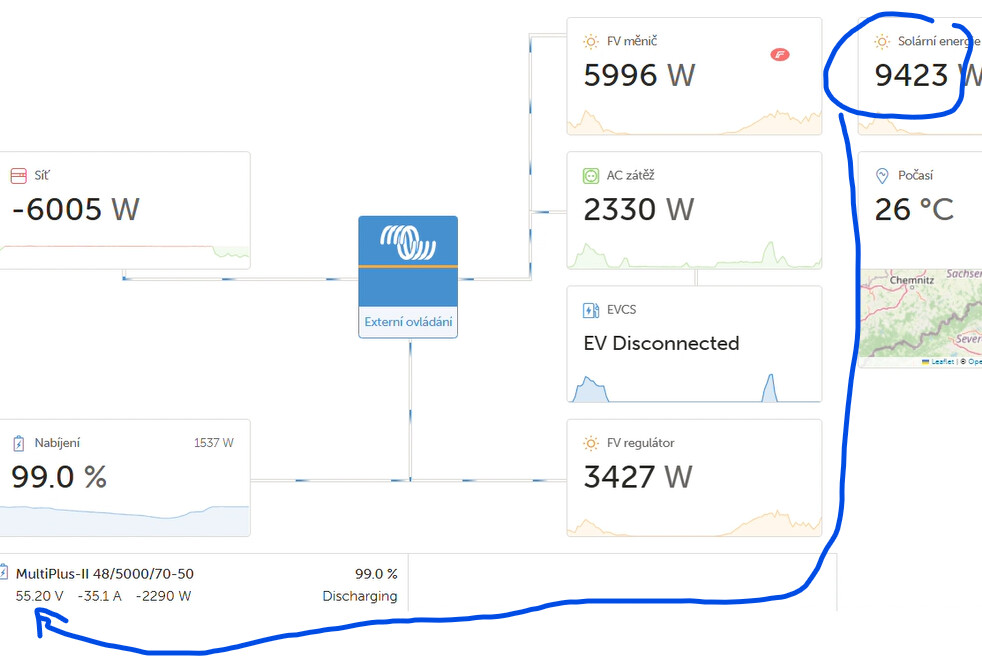
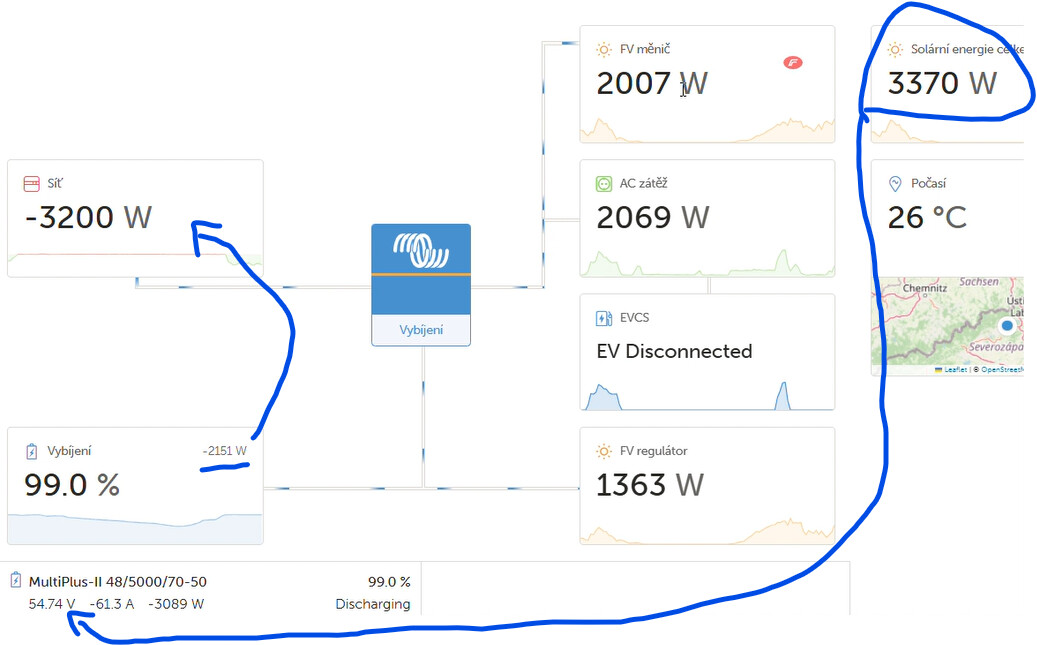
Thx that you paying attention to this
And sorry for placing it here, it should be discussed in more related threads. But it has some similarities and maybe the same cause.
We will try more accurate calibration again and will report back. But strange is that is only happening when export to grid is active, so I do not know if it is related. Perfect calibration should be done by activating SVS - also tried with no results as you can see in the other threads. There are a lot of ppl with this kind of problem.
If bms want DC busbar to have 55.2 and Victron sends 55.6 for a while, after that starts panicking and discharging with 54.6 and again and again. There is some issue. No other inverter does that. If BMS wants 55.2V there can not be 55.6V on DC busbar.
This is the test, when battery CVL is 55.8V, and victron Voltage limit is set to 55.2V. As you can see victron sometimes sends 55.4V which results in 10A going to battery… And the reporting has some “averaging in time”, if you watch in the real time peaks are much higher.
Balancers have nothing to do with that, all cells are balanced, they are true A grades balancing starts at 0.01V difference to not balance all the time and waste energy. Balancers kick in at 3.45V per cell. BMS does not report discharge when balancing. Current measurements for charge discharge are on a different place. Balancing state is not reported in any way to inverter.
@dognose
Testing continues with charging discharging problem. It is not related only to JK, JBD is also affected.
I tried battery voltage calibration by calibrated multimeter. Nothing happened. So I have compared data against Pylontech batteries and only what I can see is that Pylontech on the left has two MPPTs in “Voltage or current limited” and one “MPPT Active”
These data are before calibration, but there is not any difference, maybe little faster switching between charge and discharge without calibration. Also what you can see, pylontech battery calibration is 0.3V off from Victron VE bus all the time.
On the right is JK. Two MPPTs total both in “MPPT Active”. Besides of that, nothing special. You can see that JK is charging, discharging, charging, discharging… Pylontech is still. CCL from BMS is not the case either, pylontech can be still even with CCL 15A requested. So I am clueless what can be the cause - only mosfets disabled on pylontech comes to my mind…please help Maybe something in VE config? I do not know.
This picutre: CVL from battery is all the time 54.8V. In which world can inverter send 55.2V that is 0.4V more on battery busbar and later 54.6V. And why it sends battery power to the grid?
Now there is a million dollar question. How to handle this. I think Victron should disabled this addition somewhere. Otherwise BMS like JK, that does not send maximum charging voltage and does not rely on overcharging of cells to 3,65V to set battery to 100% resulting in disabled mosfets is impossible to set. And these types of BMSes with better charging behaviour will be more and more.
JK cannot send to Victron “Charge voltage setpoint” atleast 0.4V lower all the time to compensate for Victrons bad behaviour in case selling to grid.
Or can BMS overwrite this Victrons +0.4V addition?
And when you check other type of BMS - JBD. Even that does not help and battery is fluctuating between 55.2V and 55.6V (charge voltage setpoint) and causing same bad behaviour.
So does battery really needs to disable mosfets when charged to be able to work with Victron???
For the “Start Balancing Voltage” I’ve configure 3.45V and for the “Balance Trig. Volt (V)” (I guess you mean this with Voltage Difference Threshold I’ve 0.010V configured.
Made a screen recording of this flipping situation, in case it helps the discussion. At sec 46 you see the JKBMS SOC is set to 100&, the CVL voltage in the DVCC parameter is set to 53.6V and it started discharing the batteries. And more important the solar PV generation is reduced to almost zero!!
My setup: Multi RS Solar (two strings solar pannels connected) and 2 in-depended MPPT’s with each their own solar pannel strings).
The Victron System discharges to 53.6V, since it tires to follow the requested CVL. Since the Inverter can not export more than 5kW to the grid, the MPPTs are temporarily switched off. They will ramp up again, once the targeted CVL is reached.
The real problem is the current oscillation of +10A and -10A before sec 46. I hope, Victron can have a look into that issue soon
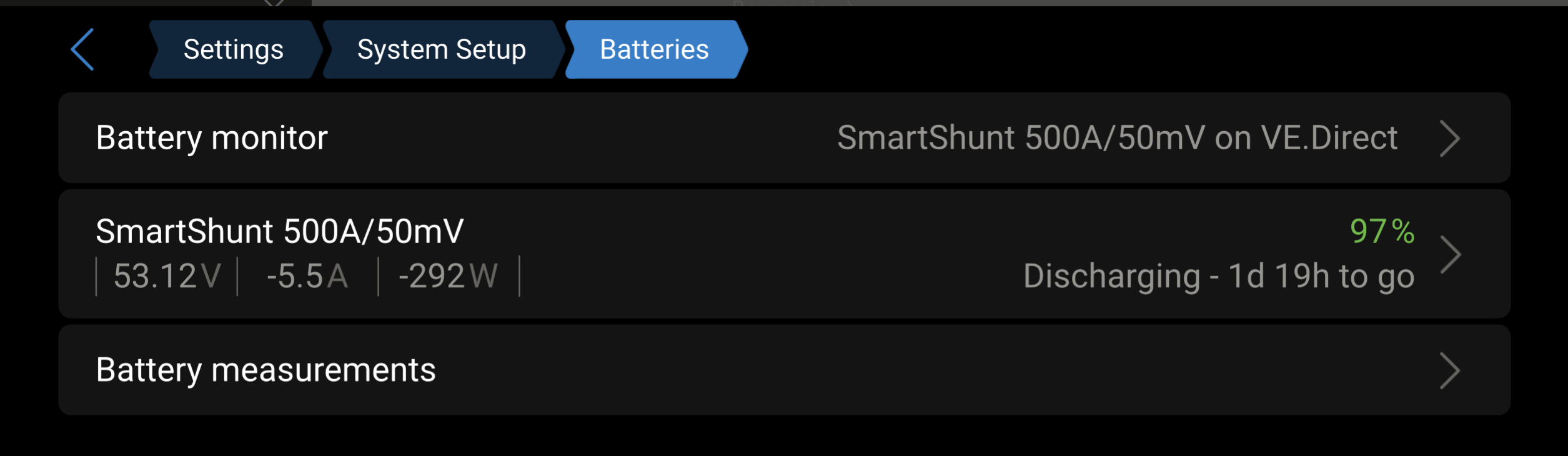
Right now, the only fix is to install a SmartShunt and set it as your main battery monitor.
I have set RCV and RFV equal in the JK. RCV=RFV=3.45V. Now I no longer have any problems with the maximum discharge at 100% SOC.
I assume you have DESS turned on. The batteries will not stay at 100% for very long. I think 55.2V will not harm the batteries.
SOC 91% → 100%?
Have you calibrated the voltage and charge and discharge current in the JK?
Especially charge& discharge current is not very easy to calibrate accurately. (clamp meter)
BTW, I’m going to install a SmartShunt to get a reliable SOC.
Thanks @Raphael_Hofmann for the explanation. This is what I understood from the above discussion.
Indeed I hope Victron can find a solution for this. @dognose@mpvader are you able to check this and address this within the Victron team?
How do you see this as a solution? Can you explain? I’ve a SmartShunt, it is installed, used for monitoring but not for steering the system. How would you do that? And what are the pro’s and con’s?
Ok, clear can test that as well. Indeed DESS is enabled. Any negative for this config?
Indeed DESS is enabled and I don’t see the SOC stating on 100% for a long time. But that can also be because of the unloading behavior that we are now experiencing.
Because when the 55.2V is hit, the JKBMS time start running, at the end of this timer the BMS checks if the voltage is still 55.2V, if so, the SOC is set back to 100% assuming the batteries are full. As this situation didn’t happen for a long time, and today with a lot of sun, the system stayed on the 55.2V for an hour if I remember correctly.
Calibrating is still something on the todo list. I’ve a clamp meter. Going to do that soon. First I want to understand how to balance the cells, it should become time for that as well.
Similar question as above post, how do you see this as a solution. I’ve the SmartShunt installed for monitoring purposes, but for steering. How would you set this up? With a bit more background info I go do some testing.
Also you can try those DVCC settings…I disabled BMS control for redundancy.
If you switch off BMS Control, the BMS will have no influence on charge voltage and charge current. The charge voltage setting of the Inverter/Charger (e.g. MultiPlus-II) will be used in this case.
This setting can be used, if you wand to build a more reduntant system that does not depend on any communication cable to be plugged into your battery bank.
You might also want to switch off BMS control, if more than 16 palallel batteries are used. In this case you also need a external SmartShunt or LynxShunt for accurate current readings.
If you switch off BMS control, you have to do following steps:
The advantage of this configuration is that the Multi RS Solar (in my case) and the two MPPTs are in control for the absorption and float mode (and voltage levels). This means that when the absorption mode goes into the float mode, the Multi RS Solar and the MPPT’s will drop the voltage and that is it, no trigger from the BMS to start discharging, is my understanding correct?
The JKBMS still is in control over the overcharging and under discharging, it will switch off the JKBMS (and thus the charging/discharing) when the boundaries are hit?
I’ve the Lynx shunt installed, I assume the above config will work in the Lynx shunt as well (is the SmartShunt?).
Even I post a lot of observing from Victron It is my first week in this ecosystem, I work with Deye as my primary system. Can you please tell me, if there is no Shunt installed, and I want to try controlling the system without BMS coms… should be DVCC disabled? or enabled and set BMS control to “No BMS control”?
You can have DVCC enabled and at the same time you can select “No BMS control”. The sytem will than use the Voltage, Current, SOC, Temperature from the BMS but will not listen to the Charge Voltage Limit (CVL), Charge Current Limit (CCL) and Discharge Current Limit (DCL) from the BMS.
That sounds good. I will try that if it has an impact on charging discharging issue.
And do you recommend this settings or should I disable DVCC totally?
I recommend to switch on DVCC. Than you have one point of truth that all the devices can use and Voltage drop over the cables does not matter that much.
But you can play around and figure out, what works best for your system.
Read the documentation:
@RGroothuis@k3ivi@Raphael_Hofmann
Can we please stay on-topic, otherwise this post is flodded with other topics. Just open a new topic if you have questions about something else not related to this topic, thanks.
JK does not control current. And it does control voltage. Bonus is that even if BMS controlled CCL, it is being ingored when export to grid is enabled.
Yes, the Pylontechs are 15s, and “there” Victron is overriding the CVL of the battery (53.x) with 52.4 max as you noted. (That is outlined in the battery compatibility guide, to prevent frequent overvoltage alerts happening otherwise)
That the charge Voltage is raised, when feedin is enabled, is “normal” - Otherwise the battery could not be hold at 100%. If battery and MPPTs would run at the same voltage, the multis would draw power from both, when trying to feedin.
So, the MP has to act as “Man in the middle” to grab the power from the mppts, but leave the battery “idle”.
One thought: Did you obey the installation rule to have all MPPTs connected with equal cable length and diameters? (Or more precicse: identical resistances, which may involve bad connections as well). Different Voltage Drop of the MPPTs may result in different voltages there, making the MP unable to find that “sweetspot” in the middle, where the battery just idles. (Just a guess, i’m no Installer or DC-Expert)
An easy way to verify maybe to disconnect all but 1 MPPT and see if the issue still occurs.